Post-Concussion Syndrome & Traumatic Brain Injury

PCS Treatment That Identifies What a Normal MRI Can't Show

We measure the neurological systems responsible for regulating blood flow to the brain — the variables standard concussion care never looks at.


Is this you?

If any of these sound familiar, you're in the right place.

Schedule a Free Consultation
Keiser Clinic patient in waiting room recliner

Most PCS workups end with "your scan is normal." Ours starts with what the scan can't see.

A normal MRI rules out bleeding and structural damage. It does not measure whether your brain is regulating blood flow correctly, whether your vestibular reflexes are misfiring, or whether neurovascular coupling has broken down after your injury. Those are functional failures — and they don't show up on standard imaging. That's where we begin.

Data Callout
Up to 30% of concussion patients develop persistent symptoms lasting months or years. Why? Because most concussion care is built around structural imaging that was never designed to detect functional neurological failure. A normal scan doesn't mean nothing is wrong. It means the wrong variables were measured.

It starts with a consultation.

Before booking your visit, schedule a free phone consultation with a Keiser Clinic physician. They'll listen to your story, answer your questions, and tell you plainly whether coming in makes sense for your situation.

Schedule a Free Consultation

What to expect

  • A physician listens to your full story
  • No false hopes — if it's not a match, you'll know after this call
  • Free — no cost to speak with a doctor

A mechanism-focused evaluation that goes beyond "your imaging is normal."

Our diagnostic workup brings cutting-edge methods from leading neurovascular and concussion research — including real-time cerebral blood flow measurement and functional neurological assessment that most concussion specialists still don't have in routine practice. We do — and we use them with every patient.

Transcranial Doppler TCD

Transcranial Doppler (TCD)

We measure blood flow to the brain in real time. After a concussion, the brain often loses its ability to regulate that flow precisely — and the moment we can show you that on a screen, the "invisible" injury becomes visible for the first time.

Capnography EtCO2

Capnography (EtCO₂)

CO₂ directly controls how brain blood vessels dilate and constrict. After concussion, breathing patterns often shift in ways that compound cerebral hypoperfusion — a variable almost nobody measures, and one of the most treatable in the picture.

Cognitive Load Testing

Exertional Threshold Testing

We identify the precise point at which physical or cognitive exertion begins to compromise cerebral blood flow — giving us an objective threshold to work within, and a measurable target to push above as you improve.

Visual and Oculomotor Assessment

Visual & Oculomotor Assessment

We assess the visual and vestibular systems using video-oculography (VOG) and pupil response testing. If these systems are misfiring, they can keep your autonomic nervous system stuck in overdrive.

Autonomic Stress Testing

Autonomic Stress Testing

We use deep breathing, Valsalva, and postural stress to measure how your autonomic system responds and recovers under challenge. Then we layer in cognitive, cervical, and visual demands, because many patients only break down under combined load. What looks manageable at rest often becomes obvious when the system is pushed.

Bedside Neurological Examination

Bedside Neurological Examination

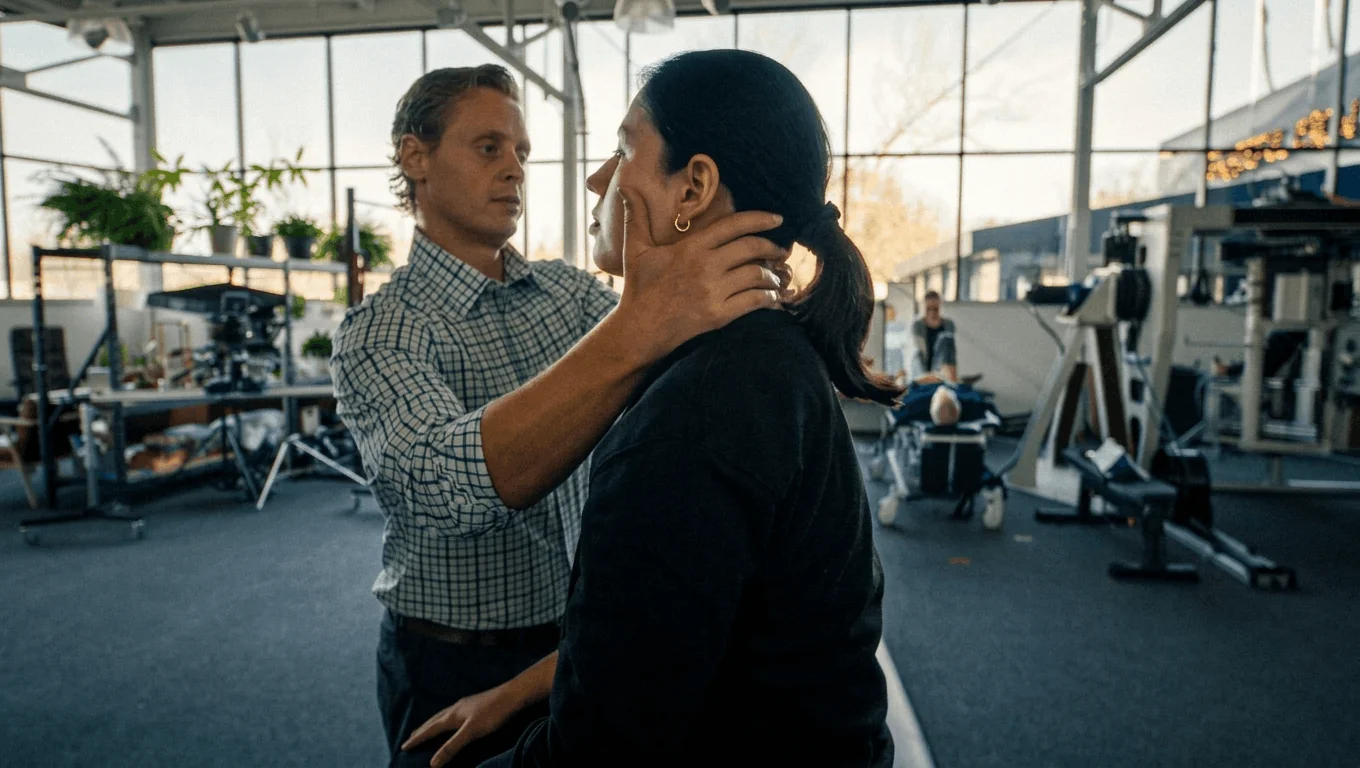
Some of the most important findings still come from an experienced doctor examining you directly. We assess reflexes, eye tracking, cervical motion, and coordination to catch the neurological patterns that may not show up on a screen.

A Note From Our Team

We know what it feels like to be on the other side of this.

Several of our doctors have been patients or caregivers themselves. They know what it feels like to be dismissed and sent home with no answers. When you become a patient here, you have a care team of doctors who understand where you've been — and what it actually takes to get better.

Your treatment plan doesn't exist until your data does.

Your rehabilitation is not a program that existed before you walked in the door. Nothing is prescribed before we know exactly where the failure is and what's driving it. Instead of rest, time, and generic PT being your only options, we prescribe an individualized neurological treatment — dose-specific to your needs, within your tolerance threshold.

We know PCS is not one thing.

Whether your primary bottleneck is vestibular, oculomotor, cervical, autonomic, or neurovascular — we strip away the labels and identify the mechanism that's failing in you specifically, so we can treat the actual problem rather than the presentation of it.

"Normal imaging" doesn't mean nothing happened.

A CT or MRI checks the structure of the brain. It does not check neurovascular coupling, cerebral autoregulation, or vestibulo-ocular reflex integrity. Those are the systems that govern function — and they can fail completely while your scan looks perfect.

We objectively measure progress.

Subjective improvement can be placebo or temporary. We don't just rely on how you feel to measure progress. We retest you objectively throughout your visit, comparing data points to verify real measurable improvement — so you leave with proof, not just hope.

After you leave.

Virtual follow-up is included in your visit. Your protocols go home with you. We check in, answer questions, and make sure you stay consistent with what's working — until you no longer need us.

Most patients who come to us carry more than one of these diagnoses. These pages exist because that is often how people find us, not because we treat each diagnosis on a separate track. Our testing measures what your brain and nervous system are actually doing. The label you arrive with does not change that.

"Standard concussion care has a ceiling. We work above it — in the brain."

Some of what you may be prescribed during your visit

Vestibular Rehabilitation

Vestibular Rehabilitation

Retrains the balance system when dizziness, motion sensitivity, visual instability, or autonomic symptoms are being worsened by vestibular dysfunction.

Visual-Spatial and Oculomotor Retraining

Visual-Spatial & Oculomotor Retraining

Targets the visual control systems that stabilize gaze and helps the brain build a more accurate map of the body in space. This can reduce neurostrain, disorientation, overload, and instability under cognitive and sensory load.

Peripheral Nerve Stimulation

Peripheral Nerve Stimulation

Uses targeted stimulation, including tools like the Neuro20 suit, to improve sensory input from the body and give the nervous system better information to regulate from.

Cervical and Manual Therapy

Cervical & Manual Therapy

Addresses mechanical strain and poor sensory signaling coming from the neck and upper cervical region, where instability can interfere with brainstem function, and autonomic regulation.

Neuromuscular Retraining

Neuromuscular Retraining

Rebuilds cleaner movement patterns so activity becomes more tolerable and less likely to trigger compensation, overload, or crash responses.

Cognitive and Dual-Task Training

Cognitive & Dual-Task Training

Challenges the brain's ability to regulate under mental load, helping improve function when symptoms flare with thinking, multitasking, or divided attention.

Exercise Rehabilitation

Exercise Rehabilitation

Uses carefully dosed activity to improve tolerance and function without relying on generic exercise protocols like CHOP or GET that ignore cerebral blood flow, autonomic limitations, and issues related to fatigue.

Photobiomodulation

Photobiomodulation

Uses red light and laser therapy to support tissue recovery, reduce irritation, and complement neurological rehabilitation in areas that need targeted stimulation.

Magnetic Therapy

Magnetic Therapy

We use the non-invasive Magnetolith in patients with ligament laxity, including hEDS, to treat tendons and joints that may be contributing to instability in joints or the upper cervical spine.

A Different Approach To Concussion Care

Category Conventional Care The Keiser Clinic
Framing Normal imaging = no structural injury. Rest and wait for recovery. Imaging checks structure. We check function — neurovascular coupling, cerebral autoregulation, and reflex integrity. These fail while scans look normal.
The Symptoms "It's likely anxiety or stress. Here's a referral." Brain fog, dizziness, light sensitivity, and crashes are measurable neurological events — not psychological responses. We find the mechanism.
Testing CT/MRI returns normal. No further workup ordered. Real-time cerebral blood flow, CO₂ reactivity, vestibular and oculomotor reflex testing, exertional threshold assessment — measuring what actually fails.
Treatment Rest, time, generic PT, and symptom management Individualized neurological protocols — built from your functional data, targeting the specific system that is your bottleneck.
Progress Patient self-report. "Give it more time." Objective retesting throughout your stay — if the data doesn't change, the protocol does.
Exertion "Avoid anything that makes symptoms worse" — no threshold identified We measure your precise exertional threshold with real-time monitoring — then use it to build capacity without triggering a crash.
Doctor Access 15–45 minute specialist visits spaced months apart Multiple hours a day with a full clinical team — with direct follow-up after you leave.

Commit only to the first day. Stay as long as you need.

We intentionally see a small number of patients each week. When you're here, you have a full clinical team — not a rotating roster of one-off appointments.

Most patients stay two to three weeks. Some stay longer. But when you arrive, the only thing you commit to upfront is that first day of diagnostic testing. What comes after is your decision.

We don't run a copy-and-paste concussion rehabilitation program. We become your care team and design a protocol specific to you.

Schedule a Free Consultation
2,000+
patients helped on their recovery journey
4–6 wks
Typical time to be seen. Most concussion specialists have waitlists measured in months, not weeks.
No Guesswork
Nothing is prescribed before we measure what's failing. Your protocol is built from your data — not a standard concussion template.
The First Day
Your only commitment. You will leave with the most comprehensive neurovascular evaluation available for PCS — regardless of what you decide next.
Common Questions

Before you reach out, you probably have questions.

Yes. It's 15 minutes with one of our physicians. No cost, no obligation. We use it to determine if our approach matches your situation.
Most concussion protocols follow a return-to-play timeline and assume recovery happens with rest. When it doesn't, patients are often told to keep waiting. Our evaluation looks at what's actually still broken — cerebral blood flow regulation, vestibular dysfunction, oculomotor impairment, cervical instability — the specific neurological failures that keep patients symptomatic long after the standard timeline says they should be better.
Not at the beginning. The first phase of care has to happen in person, because we do not build treatment plans from symptoms, diagnostic labels, or guesswork. We need objective testing and in-person treatment to understand what is driving your symptoms and to see how your system responds in real time. Once that work is done, post-visit virtual follow-up is included in your care.
That is one of the most common concerns we hear, especially from patients who have been mostly housebound or bedridden. Many of our patients were convinced they were too unwell to make the trip — right up until they arrived. Our team can help you think through the logistics, timing, and lodging options that make the visit as manageable as possible.
We're out of network for most insurance. Many patients use HSA/FSA funds, and we provide superbills for potential reimbursement. We've chosen this model because we don't want your care limited by what insurance allows.
The total cost depends on how long you stay and what level of treatment makes sense once your findings are clear. That is exactly why we start with a free consultation. Once we understand your specific situation, we will give you a clear, straightforward breakdown of the costs before you commit to anything.
No. You can book directly.
We will be honest with you. By the time most people find us, they have already been through a lot — physically, emotionally, and financially. The last thing they need is another clinic giving them false hope. If we do not believe our approach is the right fit, we will tell you plainly.

Want to hear directly from patients who've been through this?

Read POTS & dysautonomia recovery stories →

Start with a free consultation call.

A Keiser Clinic physician will listen to your story, answer your questions, and tell you plainly whether coming in makes sense for your situation. No pressure. No false hopes.

Schedule Your Free Call