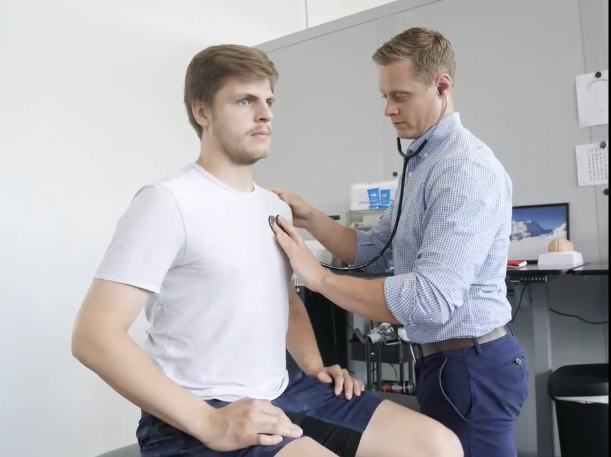
Today I want to share with you guys a case study. This is a case of someone with a post-concussion autonomic syndrome. I want to walk you through what we found, my thinking process going through that, and then the outcome.
What We Were Dealing With
Mid-20s person, head injury, long-term duration symptoms. So the main things we're dealing with are dizziness — and dizziness is a good word to try to figure out. In this case, dizziness is a sense of disequilibrium or feeling like you're kind of wobbling on the ground. People will describe it as drunk or like they're on a boat. That's kind of the dizziness we're talking about here.
The second thing was a transient tachycardia — meaning spikes in their heart rate. So the heart rate would spike up to 150, 170 depending on what they were doing. Also had hyperhidrosis — like really sweaty hands and feet, really hot, just kind of clammy all the time. And the last thing was a sense of nausea that was pretty frequent. That frequency of nausea could also be associated with vomiting sometimes, and also meant that sleep was really difficult. Both falling asleep and then staying asleep in the morning were really hard. So a lot of interrupted sleep.
The Eye Test That Showed Us Everything
So this is a picture — a cutout of the video oculography. The test that we're doing here we call it occluded vertical saccades. So it's self-paced saccades up and down — they look up, look down, look up, look down. And what you're doing is it's in the dark. This is something I actually learned working with Dr. Carrick. He would have people close their eyes, look up, look down, and then open their eyes. What you're looking for is the bias — which eye muscles, when they move up and down, the ones that are stronger or have a better integration are going to deviate the eyes. They're going to actually deviate the eyes and change the axis of where a person feels like vertical is. And they help us understand the interaction between the central vestibular system and the eyes, which is super helpful.
What we would expect to see is that the eyes should just go straight up, straight down, straight up, straight down. But when you look at this one, you'll notice they come up and then if you zoom in on that right eye, you see the right eye goes up and then in. Up and then in. Up and then in. So it's got a drift — it's got two components of that movement. That inward portion of the movement where the eye is actually drifting in tells us something. It tells us that the integration that would hold those eyes up there strong like that fails, and we actually get a deviation of the right eye coming inward.
Two Sensors Working Together
If we think about all the things that would make that eye move in, that gives us some inputs on what might be happening with vestibular interactions. And then what we have to think about with cervical interactions — in other words, you've got two sensors that kind of work together. You've got the joints and muscles in your neck that help you to move your head and help you understand where your head is at. Same thing with your inner ear — your inner ear also helps you understand where your head is at. So they work together to be able to give information that ultimately puts together the picture of where your head is in space. And then your eyes contribute to that as well. So in this case we can see that that central vestibular system is failing.
We want to measure it — is this just something that's happening in the dark with the head still, or does it happen in other environments as well? When we have them stand with the head still we can do something called a Maddox Rod test and it helps us to actually measure what the angle is, or the difference between where those two eyes are looking. And with this case, at 20 feet, it's a large change — over 10 inches of change, which is a very significant amount of deviation of the eye.
Suppression — When the Brain Shuts Off One Camera
When two eyes don't look in the same place over time, you can think of them like two cameras. But if those two cameras aren't pointed in the same place, those two cameras will be picking up different images. And when two cameras pick up different images, they go to one brain — the brain is not thrilled about that. So what it will do is it will take one and actually suppress it. It will take one of those images and say nope, we're not doing that, and it will block it out. This is called suppression amblyopia. And we see that was present in this case, obviously because we don't have two eyes looking in the same place. But then also the peripheral fields on the right side were skewed as well — so the ability to detect depth in the right field was different.
Figuring Out Neck vs. Inner Ear
So we know we've had — still, whether they're in the dark or whether looking around — the eyes aren't lined up very well. We want to challenge that in a couple different ways. From the history, aggravating factors — things that made the symptoms worse — were things that had a high visual environment or high context of visual environment, a lot of movement. Things like driving, things like being in a busy space. Then also things that had a lot of head movement involved where there's a lot of turning and moving around — those things were also irritants as well.
So the next step was to kind of differentiate what is the involvement of the neck versus what is the involvement of the inner ear, so we understand how do we want to put these together to be able to develop the treatment outcome.
We looked at head following — basically having them look at a target and then be able to move their head and eyes in a coordinated way to follow the target. What will happen is a lot of times when we have these kind of interruptions, their eyes will move way more, way out of plane compared to their heads. We can see that the eye will deviate over more than the head does rather than keeping the eye still in the middle. We saw that was the case here. So we know that there's an increased tonus in the neck, meaning they don't control it as well. And we also found that with those head turns it created different disparity within the Maddox Rod testing — it actually made it worse turning the head to either side.
We then did palpation — we know that the eye wants to turn in, that's where the preference is. So if we think about turning the head to the left, that would oppose the right eye turning in, right? So what I did was palpate the neck and feel the way the joints would move turning the head to the left, and I just kept the head still and pressed into those joints. We saw the same thing happen — we would actually see that eye dip in and then the spread between the two gets bigger. So we know that the neck does have involvement and we know that the inner ear does have involvement. So that tells us that where those two signals combine is probably where we're looking at a problem.
Step One — The Otolithic Repositioning
OK so what do you do about that? Because we had the static positioning change that's going to be affected from otolithic information, and then also a dynamic change when we put the neck involvement in, the first thing we chose to do was to do an otolithic repositioning. We just use a static — I might say static, that means holding the head in a position — but holding it in a position that gives a different signal than the one that is currently available. So that signal, the noise in that signal is so high, there's so much extra noise coming in, that we want to reduce that noise and if we can reduce that noise, we get a better signal from the area.
So we do an otolithic repositioning, but when we do it, I position the head just slightly off to the left, a left bias, and I kind of manipulate the neck joint in a way that promotes that left rotation. That puts them in a null position of the eyes so they don't drift anymore. That's kind of complicated, but I'm just walking through what I did.
So his head is slightly to the left and we do that repositioning maneuver laying down. And then we retest the goggles. And when we retest the goggles and we look at his eyes moving up and down again — you see the right eye comes up and it holds. It doesn't slide back into the same degree, right? Which is pretty cool.
Because that doesn't slide back in anymore, it lets us understand how we can use this mechanism to help him out. We tested immediately after that, we looked at the Maddox Rod as well, and we see the discrepancy shrinks. And then the cool part is we actually see the suppression of that right eye goes away. So we can see with both eyes, which is pretty cool.
Step Two — Hold the Anti-Suppression
So then the next goal is — can we get that suppression, or the anti-suppression, the amblyopia, to go away for a period of time? So we check the next morning, letting them just kind of do their thing and then look at it again. And we can see that the anti-suppression stays — they're still not suppressing the vision, which is great. That's what we want to hold for.
So that's goal number two — before we can make it dynamic and start moving someone's head around and having them do eye movements, what I want to do is make sure that both eyes can actually look in the same place and gather the same data at the same time. Once that's established, then we have the ability to start taking things and making them dynamic.
Step Three — Small, Slow, Dynamic
What that meant for this case was starting with these really small head movements that would cause that right eye to move outwardly. So we're using this left stimulus like this and coming back slowly. And we were really small and really slow because that's the amount of dose that could be tolerated and still maintain the binocular vision.
So we do really small turns, really slow, and then we would also control the neck movement at the same time. So we're getting the ear to match the neck while you're also matching your eyes, so to speak. We're kind of matching all these things together. And what we've found is that doing them on a very low and slow, simple basis gets us further faster than trying to make it very complex very quickly. So we focus on the one thing and we work on that one thing until we're able to establish that integrity.
“What's really cool is watching how we take these really simple movements, these really simple things that we're just rebuilding bit by bit by bit like little Legos. And as you build them, you watch their resilience go up and up and up.”
Once we can couple the cervical mobilization — they could move their head without losing that suppression, without the eyes drifting and wandering — then we say okay cool, we can do that on this plane, and look, we can look at the thing, move the head, and everything lines up and matches.
Where the Symptoms Fit In
I kind of skipped over this, got ahead of myself, but one of the things we saw early on — so we would cover the eye in the exam and follow out just with the right eye because it wants to drift in. And we follow out with that right eye — immediately you felt symptoms. Heart rate spike, sweaty, nauseous, feel like they're on a boat. Immediately, just taking that right eye out. And as you do it, it kind of bounces around, can't hold it very well.
So after doing the maneuver — do the same thing, no symptoms. Next morning, checking suppression — no symptoms. Doing the VOR maneuvers — no symptoms. And we actually see sleep got better. Able to tolerate more. Go for a drive, go be outside, at dinner — all with all of those things get stronger.
Step Four — Changing the Depth Field
The last bit that we did was — now that we are able to hold this at this phase, we can create dynamic movement with the head and neck. Now we want to change the depth field. That's the fourth piece — taking that skill that is available at one depth, watching a screen or looking at the wall, how do we translate that from near to far and be able to keep those eyes looking at the same thing, holding that same data without suppressing it, and then still being able to move the head and neck and body around to change the environment? So you can still hold that all together.
So we would do that same VOR but using a tool that allowed them to get feedback about if they were maintaining binocular vision with both eyes. So if it lost it, you got feedback right away saying oh, I slipped, they didn't hang on, they weren't both looking in the same spot. Redo it, start again, go smaller, go slower, go smoother.
And by doing that over and over and over again, we're able to build out that depth field. So it starts in a range like this and then we expand it both to get closer and to get farther away. We just kind of expand it out. So we're changing that depth field and that allows a person to be able to move from being in one plane environment into being able to tolerate being in a small room versus being in a big open space, and to be able to make that shift between them without becoming symptomatic.
The Progression
So by moving through that kind of process — we work on: can you tolerate just not having the sense of movement or the motion while we're being still? Can we get rid of that? And can we translate that into being able to use both of those cameras to see at the same time? Then transferring that into dynamic head movement, dynamic movement of the body — being able to take what was still and transfer that to movement. And once we have movement, can we do the same thing at different depths? That's kind of the progression that we're going through in a case like this.
Whether you're a doc, whether you're a physician, a therapist, or whether you're a patient who's been going through something like this or know someone that's going through something like this — I hope that this kind of a walkthrough is helpful. I think it's very hard sometimes to understand how exactly is the thing that we do different. And hopefully this sheds a little bit of light on how we're trying to solve different problems. And because we're trying to solve a different problem, we're trying to do it in a pretty unique way. It allows us to be able to help cases that typically kind of don't make it through other systems because people don't know what to do and then they get washed out.
Concussion Symptoms That Won't Resolve?
If you're dealing with dizziness, heart rate spikes, or nausea that hasn't gone away after a concussion, a free consultation call can help figure out whether our approach fits your situation.
I'm Ready to Get Better