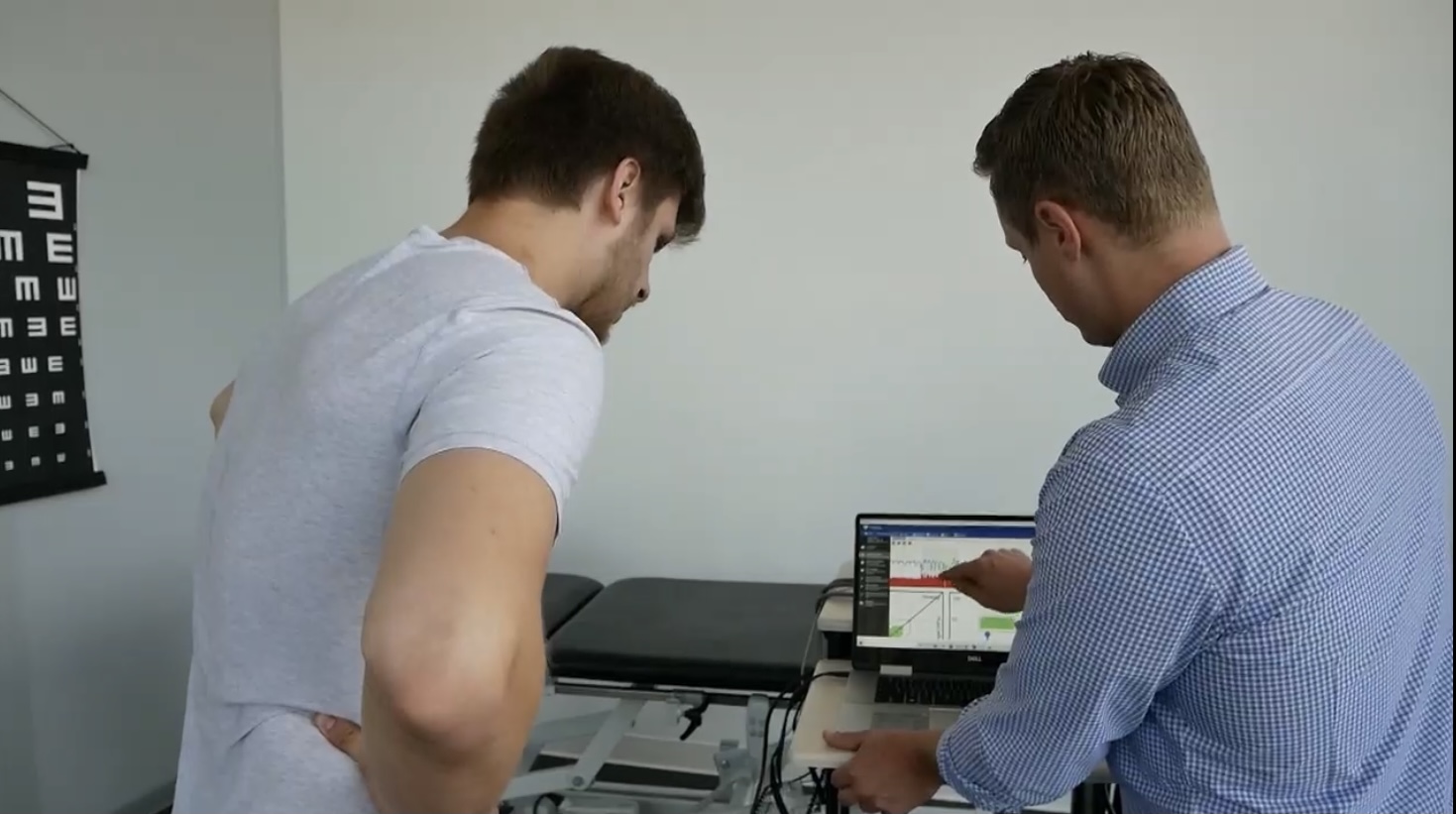
So let's say you're someone that has EDS, walking around living your life, then you get sick and you develop POTS. What do you do about that? I want to share with you guys today a case of someone who walked through just that — and how we were able to take that history that had been long and protracted, multiple years, and within about a month get that person up and running again.
Starting With the EDS Component
So Ehlers-Danlos Syndrome — it's a genetic condition, and in the type we're looking at here it's specific to the hypermobile type, which means people tend to be hyper flexible. Their joints have more range of motion than typical. We can measure that using simple Beighton scores, you can also do genetic testing to understand if this is you, but typically the way this looks is someone is very, very flexible. Lots of range of motion in their joints. Their knees kind of buckle backwards, their elbows buckle backwards, they can move their wrists more than they should.
I think it's really important to start with this Ehlers-Danlos component because it's genetic, right? So you have it, fine. But also, I've seen like a load of people — when you see videos of people with no arms that are world-class archers, you see people with no legs that are world-class wrestlers. So in this particular circumstance with Ehlers-Danlos, from my experience what I have seen, it doesn't have to be something that completely voids your ability to have a healthy, happy, productive life. But it is something that we have to have a lifestyle around so that we can achieve those things.
Her Background
Over the course of about eight years she'd been experiencing some symptoms, particularly related to her GI system. A lot of trouble with digestion, bloating, not feeling well. Had some lymphatic problems in there as well — like just a tough way to spend time. Two years ago this progressed into a more severe version. Getting sick now. And then just a few months later after that, she started to have problems with being able to stand up, feeling like she's going to pass out, and then at one point fainting.
When she came in, the primary complaint — she'd been diagnosed with POTS, she was having a lot of nausea and stomach pain, she had this previous diagnosis of Ehlers-Danlos Syndrome, and extreme fatigue to the point where it was affecting her ability to go to school, affecting her ability to work and to kind of pursue the things that she was looking to do in school. So very, very big deal for a college-aged young lady.
What We Found on the Neurological Exam
We noticed a couple things relative to the neurological exam. Number one, just shining a light in her eyes causes her to have this little tremor in her head. That's not something that you would see just specific to the fact that your joints are bending or that your heart is beating fast, right?
We found that she had percussion myotonia. We tap her thenar eminence and she would get the same sort of consequence bilaterally. We start looking at changes in respiratory outputs when we see these things.
Measuring her peripheral nerves is really important because in these cases we can see changes in neuropathy — both injury to the nerve itself, but also when we have POTS, a lot of the times what we're looking at is: are they able to actually get adequate blood flow to the head? Many times that acceleration of the heart rate is in an effort to compensate to get blood into the head.
Sensory Testing: Sitting Up vs. Laying Down
In her case she had a decrease in her ability to detect temperature — both warm and cold — in the periphery of her hands and in her feet. These are small nerve fibers that don't have myelin in them, so that's very important. These are just kind of small bare-ending fibers that aren't conducting as well.
We also use a little pinwheel and we rub that on the skin. When you roll that along the skin we should feel these little pinprick sensations. What she was experiencing when she was sitting up was that they were really patchy — she could feel them in some places, not feel them in others. But it wasn't anything that went along a specific dermatome that would make us think it's coming from the spinal cord. It wasn't hemiplegic making us think that it was coming from the brain. It was this patchy type of a distribution.
We also check to make sure the color temperature that people perceive in their vision is the same bilaterally, and we want it to be the same when they're seated versus when they're laying down or when they're standing up. It should just never change. But sometimes it is posturally dependent, because the first blood vessel that comes off the middle cerebral artery is one that goes to the back of the eye and helps us detect color and visual acuity.
"Moral of the story for her is that her response was different sitting up than it was laying down — which is super important. We see that patchiness of the sensory loss attenuate, so it kind of goes away when she lays down."
So this helps us understand that there's something different about sitting up than there is laying down for her, and it affects the way that she is able to actually use her brain to process these peripheral inputs. It doesn't mean there's something wrong with her eye. It doesn't mean there's something wrong necessarily with dead nerves in her legs. But the ability to use them and detect them and work with them from a brain perspective is being impaired. So that part's super important.
Balance and Dual Tasking
So if we kind of go the opposite direction — when you're laying down things get better than they were when you were sitting up, what happens when you stand up? In this case we looked at standing just on a foam pad. Standing there, close your eyes, turn your head in both directions, tip your head forward, tip your head back. And what we're trying to see is how well your brain is able to incorporate all of these different senses and turn that into balance.
What we saw in this case was that she actually had falls, which is like a very impaired level of balance, when tipping your head forward, when turning your head to the left, and when extending your head. In all of these she compensated by turning her body to the right. It helps us understand where she feels comfortable, where she feels stable, where she feels safe — but what all of those mean is where she's able to perceive her sensory system best.
Then while standing we have her take a little walk. When she was walking and thinking, she would freeze. Every step she would kind of have to stop and halt while she was thinking. She couldn't do them both at the same time.
The Tilt Table: What Was Actually Going On
What was interesting about this case was at 7 AM — I think the test was at 9 AM — but at 7 AM she took a dose of Atenolol. That's kind of important because Atenolol should modulate heart rate, should artificially suppress the heart rate by blocking some receptors at the level of the heart. But what we found was that even though she was on that medication, she still had pretty marked changes in her physiology.
She still had a pretty sharp increase in her heart rate but it wasn't to the point of reaching pathology. Her heart rate came up 23 beats per minute, which is a lot but not enough to be considered pathological, right? Her blood pressure stayed relatively similar at about an average of 118 over 73.
But what was interesting was the change in the way that her blood was circulating carbon dioxide. Normally this level should be between 35 and 45. Hers actually dropped from a 35 when she's laying down to a 26, to a 23, to a 21 as she was standing up. And at the same time we could see that the blood flow going through the middle cerebral arteries into the brain — both sides actually dropped by more than 30 percent. Which is a pretty big drop.
"When we see decreased levels of CO2, that's called hypocapnia. It changes the concentration of CO2 in our blood flow, which changes some reflexes especially within the brain with the way we deliver blood — and actually causes vasoconstriction in the brain."
Could she feel that? She felt it right away. She marked it as lightheadedness and dizziness, which turned into nausea, shortness of breath, felt it in her stomach, felt hot, weak in the legs. Returning back down she finally felt like she could recover and breathe again, and she was still dizzy. It actually took several minutes before her end-tidal carbon dioxide level normalized and the cerebral blood flow velocity to her brain normalized.
How We Approached Treatment
So the job in this case was to think about — well, how do we then attack each of these things? We had these vestibular problems, meaning we have to do something that allows her to understand where her head is. If she's got this drift of her eyes or this perception of movement in her head, any movement or change of position is going to be met with an inaccurate motor response. She's not going to be able to send blood to her head in an effective way.
We also see this patchiness in the nerves. We're going to use that as a way to see if we can increase the firing rate into the brain. And then we also saw that there was an element of changing the position of her head and neck that changed the blood flow into her head when she was laying down.
So we built a series of exercises that could take us from that position of stability when she's laying down, changing the orientation of her head and neck to stimulate the joints in her neck in a different way so that she could maintain the blood flow, and then doing the vestibular rehab to gently move her through space in a way that she could tolerate.
We basically do that tilt table, but rather than do the test where we go up and down, we do these small exercise versions of it. So like if you imagine if you were recovering from being sick and you couldn't go for a walk, but maybe you could start out by just standing up and just picking your feet up and down, right? So maybe you're not able to walk yet but even just picking your feet up you start to get out of breath — you work but eventually you get stronger again. You take the thing you want to do and you break it down into smaller chunks and then you rehab it like that.
The trick is if you go too hard, sometimes your symptoms feel worse, it's harder to get out of bed, it's harder to keep momentum. But if you can exercise at a rate where the symptoms aren't too bad — you're going to be uncomfortable because you're pushing the system — but it's enough to where you can recover and come back the next day and do it again.
We measured the CO2 ratio so that when she was going up, we never went past what she could tolerate. Because we did that, we never caused the vasoconstriction and never caused her to lose that blood flow to the brain. So she was able to learn how to do it on an ongoing basis — step by step by step, being able to go up higher and higher and to tolerate it.
The Results
We were able to retest the tilt test to where she could go from zero to 70 degrees without having a drop in the carbon dioxide, which is super cool. And then at the same time, because of that, she didn't have the drop in the mean arterial blood flow — meaning she's keeping blood in her head. Which is amazing.
From there we can say, OK well if that's true and she can stand up and deliver blood to her head, let's look at some of the other things that went with that. We're not seeing the change in her vision anymore when she's sitting up. We're not seeing the change in her sensory distribution when she's sitting up. She can stand up and close her eyes and turn her head in all these positions — so she can balance. When we put the cover on her eyes, her eyes aren't drifting and bouncing anymore causing that nystagmus. So all of those things going together means that her brain is able to compute at a higher rate and to be able to do it in more difficult contexts.
Then from there we say OK, we've got these things set up, here are some exercises that we're going to do, and let's go ahead and do them at home. And over the course of a couple weeks of doing them at home we get a report back — things are going well, starting to look into a new job, and then obviously going back to school.
The Point I Want to Make
Sometimes we see these things like EDS, we see these things like POTS, that if we look around on the internet too long you can feel very defeatist about what your opportunities are. But if we instead flip it and say — well, how do I take this body that I have, it's the only one I get, how do I take that and train it into something that is more useful, something that we can live a happy and healthy life with?
In this case, we were able to find a way to help her do the thing that she was lacking, which is be able to move around in her environment and while at the same time be able to get a substantial amount of blood to her head to where she can do all the activities that she wanted. By not having that available, obviously we're going to be fatigued, we're going to have the symptoms that are associated with it, and we're not going to be able to live the life we want.
Struggling With EDS and POTS?
If you've been told there's nothing more to do, a free consultation call can help determine whether our approach fits your situation.
I'm Ready to Get Better