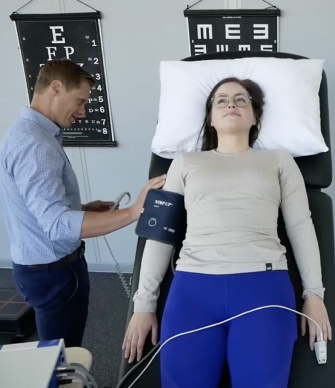
I titled this one "when the brakes fail" and I think that name is going to be apropos. This is largely talking about autonomic hyperactivity. Autonomic hyperactivity is a concept that's been around for a long time. People will also talk about it in terms of PSH, which is paroxysmal sympathetic hyperactivity. Again, a thing that's been around for a super long time. And we're going to kind of see how that actually couples with what was later kind of called hyperadrenergic POTS, but it's actually existed under different names for a super long time and it's actually more useful if we understand it that way.
Two Ways to Think About Orthostatic Symptoms
So we've got symptoms that kind of mimic the things that we would think about with cerebral hypoperfusion. Lightheadedness, dizziness, presyncope — which is feeling like you're going to pass out. Tiredness, weakness, difficulty with concentration, blurred or dim or tunneling vision. And that might be blurred vision in one eye or the other. Blurred vision overall, maybe our colors are getting a little weird. Or we're starting to see that blackout. Blackout usually comes kind of like the old Looney Tunes intro-outro and then they come back out, or might sunset down on you. Muffled hearing — we talked about that a lot today in the office, very useful. And then tinnitus is one you don't think about a lot.
And then we can think about it in terms of sympathetic activation. The way I think about that is a way to understand like — we are trying to produce some energy because for some reason my brain feels like something's up and I need to be able to get some more activity going. So these are palpitations, chest pain, shortness of breath, hard time breathing, tremulousness. A lot of people will note that they feel shaky or have tremors. Sweating — and sweating can be different kinds, but just abnormal types of sweating. Also, a lot of people will notice that they don't sweat either. Kind of an interesting deal. Anxiety, nausea, fecal urgency — feeling like you got to go take a number two — and then headache is super common as well.
The Three Main Reasons It Happens
So when we think about these sympathetic activation symptoms, one of the big questions we have to ask is: why is it being activated?
Number one — is it a normal reaction? Is it something that your body is trying to do to be able to help you out? A compensation from the system to a thing that it should do?
Number two — is it overactivated, meaning there's not a feedback loop that's closing? And an example of a feedback loop would be like — I'm hungry, I eat a steak, I'm not hungry anymore, I stop eating the steak, right? So that would be the feedback loop. I do the action, I get a sensation that changes, the action changes. So this feedback loop might be something like a baroreceptor system — the pressure is high, I need to pull the pressure back, I pull the pressure back. Pressure is low, I need to push the blood pressure up, stabilizes out. But if we have a scenario where that feedback loop breaks down, I may continue just going and going and going because I haven't gotten the signal that I need to stop or to change the action.
And then number three — this one's really going to come up a lot. Normally the way things are structured in the brain is the underlying, more primitive component of the brain is active — brain stem, for example. And then the more new, the less primitive, the more advanced, the more civilized version of your brain is going to come down and it provides an inhibition of that lower area that kind of holds it in check. And that way when you want to activate that system, all you do is just let off some of the inhibition. You take the brakes off a little bit and you let it go.
"When you stop the inhibition, we're all gas, no brakes on whatever that thing is from the lower order."
Why It Can Come From So Many Different Places
So the pathophysiology of autonomic hyperactivity — very simple. We get an injury to the neuraxis at multiple different levels. Neuraxis is the fancy word for how we say the neurological system going from the brain down all the way through its levels to the peripheral nerves. So we kind of organize the way we think about it in terms of where it's at in the brain. The peripheral nerves would be one level, the spinal cord would be another level, the brain stem would be a level. And we kind of separate that out from what happens with the lower brain stem and the upper brain stem. We separate that from the cerebellum and then from the thalamus and then from the cerebral cortex. So if we all do it in a hierarchy like a pyramid, we call that the neuraxis.
So the interesting thing about when we see autonomic hyperactivity, especially sympathetic hyperactivity — they can happen at multiple levels throughout the neuraxis. So it's really hard to just say, "Hey, they check the box for sympathetic hyperactivity. We just apply this thing. Problem solved." And the reason we can't do that is because it could be problems in multiple different areas. We don't know which one without investigating. This is a common theme for me and what I'm trying to share with you.
How the Sympathetic Chain Works, Step by Step
Sympathetic activation originates from the hypothalamus. This is an area kind of between your frontal lobe and the brain stem. Let's say our frontal lobe talks to that brain stem and off we go. We can see that we get activation of the paraventricular nucleus, the dorsomedial nucleus, and the lateral hypothalamic area. And the RVLM — the rostral ventrolateral medulla. And from there we can see the outputs that come to the sympathetic nervous system, and that's what controls this whole train.
The paraventricular nucleus of the hypothalamus is responsible for acute stress responses — stuff that's happening right now. It helps to mobilize, create the energy so that we can do the thing to deal with whatever stressor we have, whether that's confronting it, avoiding it, whatever that is. Specific to blood pressure, the RVLM controls beat-to-beat blood pressure level, keeps it stable through sympathetic output, and that is modulated by the baroreceptor reflex.
What it means to say is we have these really cool areas in the brain. They go stepwise down as we're going out into the system that help to control this sympathetic output. And at every level of control, it allows us to be able to be a little more nuanced in that activation. But then it also means that that's the spot where things can get a little wild on you.
What Can Cause It to Go Wrong
So a lot of different things can cause autonomic hyperactivity. Hypoxia — that can be acute or chronic. Global and focal ischemia, which is like a lack of blood flow to the brain that happens usually in terms of stroke, but they can be focal, which is like a small area, or global or regional that affects bigger areas. Traumas — car accidents, sports, falling, those sorts of deals. Diffuse axonal damage, which tends to come from — axons are basically these wires that connect in our brain and we can have problems where if we get a shear or like a quick movement, the axons can shear and kind of break, and that's where we see a lot of brain injuries. And then other things that cause intracranial pressure like hemorrhages. Spinal cord injuries. And then denervation, which is going to be peripheral.
The other thing that can get you is if we get changes in GABA or glutamate transmission. Because these are the currency. These are the main neurochemistry that is being used in this inhibitory exchange.
Why Beta Blockers Don't Fix the Actual Problem
So we work backwards. We think about — OK, I've got high heart rate. I've got changes in my blood pressure. Usually it's going to be a higher blood pressure, right? But I also may have changes in the cerebral regulation that's changing blood flow to my brain. This is what we see or what's often classified in hyperadrenergic POTS where the heart rate's screaming up, blood pressure could be high or stable, we're sweating, you're anxious, all the things.
So if those are running rampant and they're not being inhibited, anything that causes us to lose inhibition down in that brain stem area is going to cause that to just run wild and be overexcited, overactive. That can happen with things in the cerebral cortex — a head injury, some frontal lobe issues, parietal lobe issues where I don't feel my body very well. Could be things that are happening with the limbic drive where I don't have this cortical output to be able to control my limbic arousal. It may be things that we see change in activity in the hypothalamus. We may see problems that are happening in the medullary area.
"Most of the ways that we think about treating it have nothing to do with examining any of this. It's all around trying to chase norepinephrine levels. It's trying to use beta blockers that are just blocking the end organ out here in the heart or in the blood vessels."
We talked about the idea of a feedback loop. All of this stuff that isn't kicking in to create the normal inhibition — it's just going to keep cranking. So if you don't provide the inhibition, it just cranks, and all you're doing is blocking it at the end organ, which means it's going to crank harder.
If you've got a problem where all of the things are active, the whole RVLM activates all these different sympathetic chains. They're flipping switches everywhere all the time. Then we get this dysregulation where I'm going to have problems with sweating when I'm doing something that doesn't involve sweating. I'm going to have problems with my heart rate when I'm doing things that don't involve me having to produce more energy. So we get this spread of activity and we say, "Well, what is the thing we're going to solve for? We're just going to knock the heart rate down." Cool. But we don't change any of the other features. So then we've got to try to whack-a-mole those down in all these different ways that may or may not be useful.
What About the Parasympathetic Side?
Sometimes you can have autonomic hyperactivity that doesn't affect the sympathetic outputs, although it normally does because the loss of inhibition will tend to affect these sympathetic outputs at a much higher rate. On the parasympathetic side, we may actually induce bradycardia, hypotension, skin flushing, and then increased bronchial secretions.
These people tend to have drops in blood pressure, drops in heart rate paradoxically, right? They're more likely to — during an athletic event or they're doing something in motion — when they stop, all that blood is going to go into their muscles and then all of a sudden I'm real dizzy and then they tend to go down with both bradycardia and the dropping of cerebral perfusion.
Can you have both parasympathetic and sympathetic hyperactivity at the same time? You can. They're increasingly rare. It's not common that you see both because of the way we have this tension between tachycardia-bradycardia, hypertension-hypotension. But usually you don't see these waxing and waning ones except for when we see severe brain injuries. Sometimes we can see this oscillating between them, and we get what are called autonomic storms.
So What Do We Actually Do About It?
If we're dealing with autonomic hyperactivity, then what we really want to say is — how do we do some diagnostic evaluation in these different regions to be able to understand where our circuit breaker is flipping a switch? And then how can we address that, coming back down and creating that inhibition again?
Without knowing where the problem lies, just taking that symptom-based label and trying to shop that around to places and say "what treatments you got for this" can be really hard. And you're like, "Oh man, that person did so well with this treatment, and then you tried it and it didn't work for me. I'm a lost cause. Nothing I can do." I don't think that's a useful way to look at it. Because these symptoms can come from different parts of the brain. So it's completely reasonable that you can try stuff and it may not work perfectly because you may be aiming it at something that isn't just the thing for you.
Think You Might Have Hyperadrenergic POTS?
If your sympathetic system is running wild and nobody has looked at where the inhibition is breaking down, a free consultation call can help figure out whether a neurological workup fits your situation.
I'm Ready to Get Better