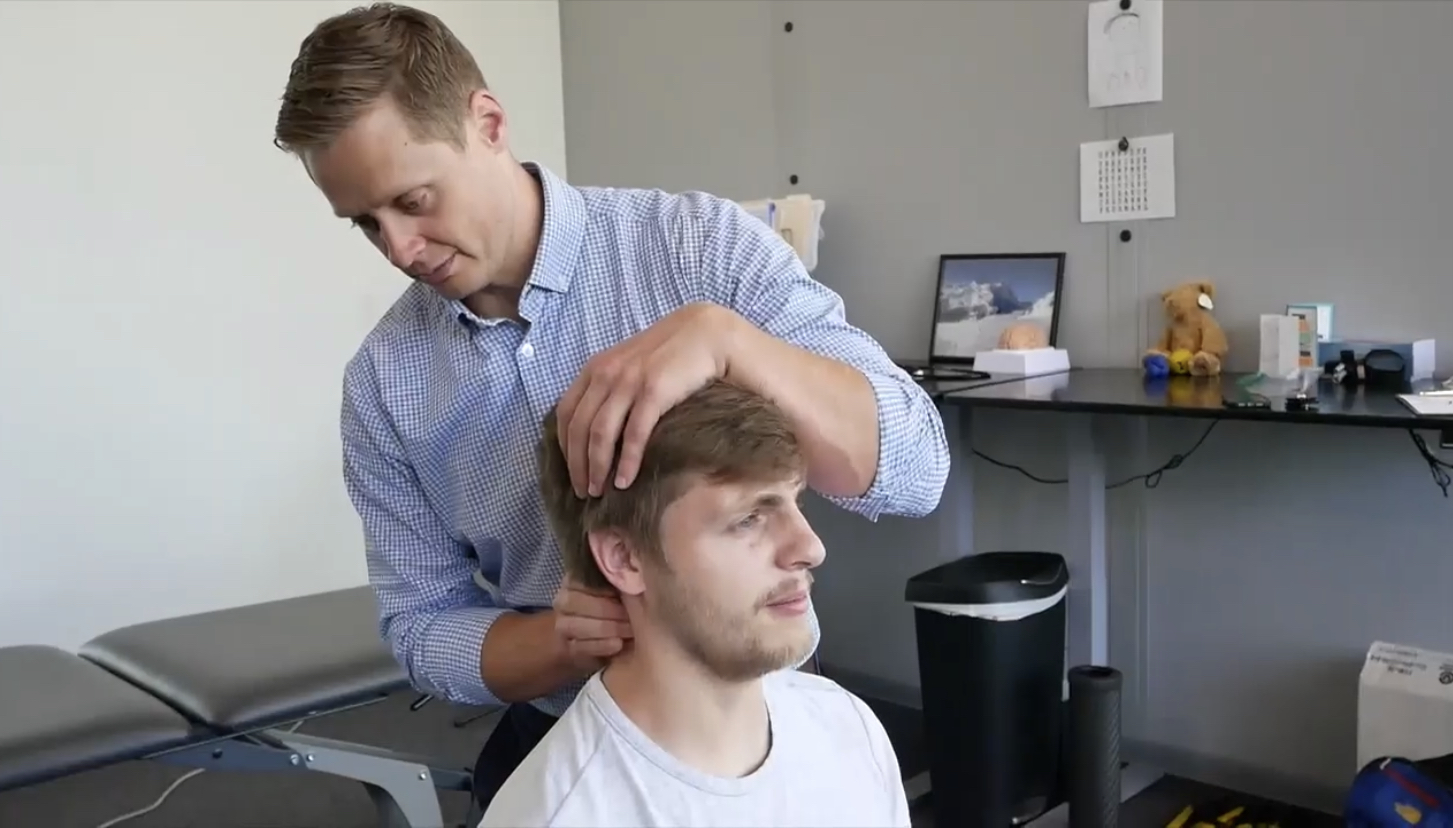
Most people think of the neck as a simple structure — it holds your head up, it turns left and right, and sometimes it gets stiff. But the cervical spine is one of the most neurologically dense regions in your entire body. It's loaded with receptors that constantly communicate with your brain about where you are in space, how to control your eyes, and how to regulate your autonomic nervous system.
When cervical joints develop errors — from whiplash, falls, repetitive strain, or postural breakdown — the consequences extend far beyond neck pain. In many cases, the neck is quietly driving symptoms that get blamed on the brain, the inner ear, or "anxiety."
Here are seven ways that cervical joint problems directly affect brain function.
1. They Confuse Your Sense of Balance
Your brain figures out where you are in space by combining three inputs: your inner ears (vestibular system), your eyes (visual system), and your neck joints (proprioceptive system). These three streams of information are supposed to agree with each other. When they do, you feel stable. When they don't, you feel dizzy, off-balance, or like the world is moving when it shouldn't be.
Your cervical spine is packed with proprioceptive receptors — sensors that tell your brain exactly where your head is positioned relative to your body. When neck joints are injured or dysfunctional, these receptors start sending inaccurate information. Now your neck is telling your brain one thing, your ears are saying something else, and your eyes are reporting a third version of reality.
The size of the mismatch dictates the size of the symptoms. A small discrepancy might cause subtle unsteadiness. A large one can produce full-blown vertigo, nausea, and the sensation that you're constantly falling. This is why so many patients with chronic dizziness have a history of neck injury — whiplash, concussion, falls — that nobody ever connected to their balance problems.
2. They Affect Your Vision
This one surprises people, but it shouldn't. Your neck and your eyes are deeply connected. Changes in your neck are tied to the positioning of your eyes, which means it can affect binocular vision, focusing, depth, how you interpret light.
Patients often describe this as blurry vision, visual overwhelm in busy environments, difficulty reading, or feeling like their eyes "can't keep up." And they go to the eye doctor, get told their eyes are fine, and leave confused. Because the eyes ARE fine. It's the neck input that's messing with the visual system.
These aren't eye problems. They're neck problems manifesting in the visual system. And until you address the cervical input, no amount of new glasses or vision therapy alone is going to fully resolve them.
3. They Cause Headaches
Most people intuitively know that neck problems can cause headaches, but the mechanism is more specific than you might think. There are distinct patterns depending on which structures are involved.
When neck muscles are irritated and develop trigger points, they create what we call musculogenic headaches — referral patterns that typically wrap around and settle behind the eyes. This is the "tension headache" that most people are familiar with.
When the joints themselves are involved, the pattern is different. Arthrogenic headaches — headaches driven by joint dysfunction — tend to wrap around the head. They feel like a band of pressure or pain that encircles the skull.
But it goes deeper than referral patterns. All this magic is going through your neck, right? You've got arterial blood vessels going up, venous blood vessels going down. You've got the sympathetic chain. You've got the vagus nerve. Cervical joint problems can compress or irritate any of these. Each one produces a different quality and location of headache, which is why "headache" as a single diagnosis is almost meaningless without understanding what's driving it.
4. They Drive Autonomic Dysfunction
This is where it gets really important — especially if you've been told you have POTS or dysautonomia.
Your cervical spine is intimately connected to your autonomic nervous system. Faulty joint input doesn't just affect balance and movement — it overstimulates or provides inaccurate signals to the brainstem, where autonomic reflexes are coordinated. When the brainstem receives bad information from the neck, it generates bad outputs.
The result? Heart palpitations that seem to come out of nowhere. Digestive problems — SIBO, alternating constipation and diarrhea, bloating — because the vagal pathways that regulate gut motility are being disrupted. Temperature dysregulation where you can't seem to get warm or you overheat at inappropriate times.
If you have POTS or dysautonomia, this is critical. Many patients with autonomic dysfunction have cervical joint errors that are actively driving their symptoms. The neck is providing faulty proprioceptive data to the brainstem, which then generates inappropriate autonomic responses — including the heart rate spikes, blood pressure instability, and GI dysfunction that define dysautonomia. Until the cervical input is corrected, the brainstem keeps responding to bad information. This is one of the most overlooked contributors to autonomic dysfunction, and it's one of the most treatable.
5. They Impair Coordination
Your cerebellum — the part of your brain that handles coordination, motor timing, and movement precision — relies heavily on proprioceptive input from the cervical spine. It needs accurate information about head and neck position to calibrate every movement you make.
When cervical proprioceptive errors feed bad data to the cerebellum, coordination suffers. You might notice that your movements feel slightly off, that you're clumsier than you used to be, or that tasks requiring fine motor precision have become harder. Some patients describe feeling like there's a "delay" between intending to move and actually moving smoothly.
This isn't a cerebellar disease. It's a cerebellar processing problem caused by corrupted input from the neck. Fix the input, and cerebellar function often improves dramatically.
6. They Affect Blood Flow to the Brain
The vertebral arteries — two of the four major arteries that supply blood to your brain — run directly through the cervical vertebrae. They literally pass through holes in the bones of your neck on their way to the brainstem and posterior brain.
When there are structural changes in the cervical spine — joint misalignment, disc pathology, muscular spasm, or ligamentous instability — these arteries can be compressed from the outside. We call this extraluminal compression. Think of it like stepping on a garden hose. The hose is fine. Something is just squeezing it.
The result is reduced cerebral blood flow. Not enough to cause a stroke in most cases, but enough to produce symptoms: lightheadedness on position changes, visual disturbances, cognitive slowing, and fatigue. Super common in patients who notice things get worse with certain head positions.
7. They Create Brain Fog and Cognitive Dysfunction
This is the culmination of everything above. When your neck is feeding your brain bad proprioceptive data, disrupting your vision, triggering headaches, dysregulating your autonomic nervous system, impairing cerebellar coordination, and reducing blood flow — your brain doesn't have the resources left over for higher-order thinking.
Brain fog from cervical problems is really just a lack of high caliber thinking. Mental fatigue — you can't think very well, you get tired really fast, you can't think through a problem all the way. Short-term memory problems where it's hard to remember the easy stuff from earlier in the day. Long-term memory problems where it's like, what is the word I'm thinking of and it's just not popping up.
And where we can really expose it is when we have people multitask or dual task. When they're doing multiple things at one time, both tasks fall apart. The ability to generate that signal, filter it through, and execute it at the same time just takes a dump on you. That's brain fog. It's a brain that's overwhelmed by the demand of operating on bad cervical input.
The Common Thread
What connects all seven of these mechanisms is that the neck is an input structure. It sends information to the brain, and the brain makes decisions based on that information. When the input is wrong, the brain's outputs — balance, vision, autonomic regulation, coordination, blood flow management, and cognition — are all affected downstream.
This is why patients with cervical joint errors so often present with a constellation of symptoms that seem unrelated: dizziness, headaches, visual disturbances, brain fog, heart palpitations, and fatigue. They're not unrelated. They're all consequences of the same faulty input.
And it's why addressing the cervical spine — not just with stretches or adjustments, but with precise correction of the joint errors that are corrupting proprioceptive signaling — can resolve symptoms that have persisted for years despite treatments that targeted everything except the actual source.
Ready to find answers?
Talk to Dr. Keiser directly about your symptoms.
Schedule a Free ConsultationThink Your Neck Might Be Driving Your Symptoms?
If you're dealing with a combination of dizziness, brain fog, headaches, or autonomic dysfunction and nobody has thoroughly evaluated your cervical spine, a free consultation call can help determine whether our approach fits your situation.
I'm Ready to Get Better