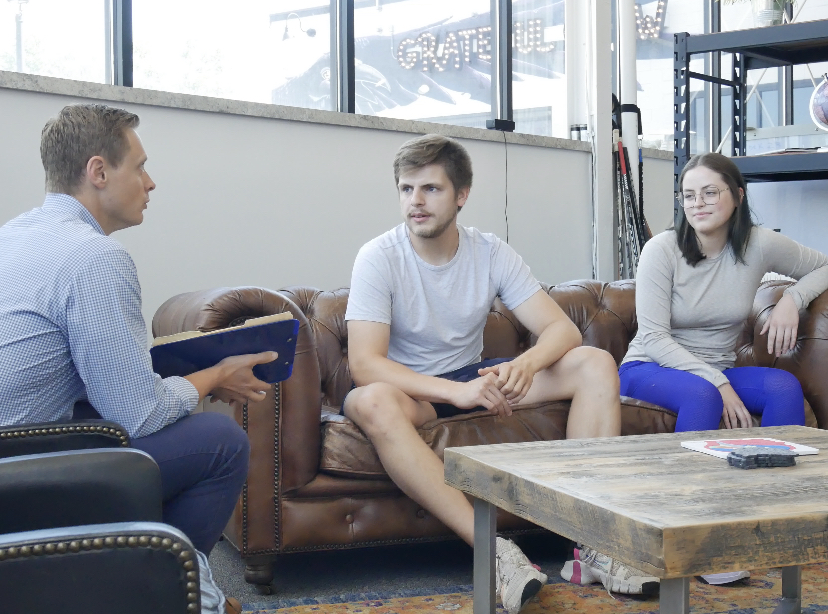
So today I want to walk through this case study about dysautonomia and gastroparesis. For any of you that are dealing with digestive problems but also having problems with dysautonomia, POTS, orthostatic hypotension — these types of neurological syndromes — I hope this is going to be useful for you.
I'm going to walk through her symptoms, the journey that got her to this point, things she's done before, things she's experienced. We're going to talk about the things she's done up to this point to try to get better, things that have been prescribed. And then from there I want to look at what did we see when we look for the underlying problem — differentiating what the symptoms are versus where things aren't functioning well. And then we'll talk about the solutions that we came up with that ultimately led to a positive outcome.
The Symptoms When She Came In
This was a 21-year-old female. She was experiencing a high level of fatigue. She's 21 years old, starting her work career, very very tired. She had a pain that she described as a brick in the lower part of her stomach, and she was sensitive all over her abdomen. She was dizzy — she described it as light-headedness, unsteadiness, not really spinning so much. She was nauseous most of the time, especially worse in the morning.
A few years prior, she had a pain in her chest, went and got her heart checked out, and they found this rare kind of rhythmic problem called Wolff-Parkinson-White syndrome. It can be very dangerous. She was able to have an ablation and resolve it, but I want to share that part because it's really important for what we're going to talk about with the coordination of her gut.
She also had a facility toward vomiting since she was very young, since birth. Most days she's dizzy. She wakes up sick in the morning. And that's kind of the current status of where she's at when she came to the clinic.
The Previous Workup
So two years prior to our exam she had been to a specialty dysautonomia clinic here in the Midwest and they did a super great in-depth workup. She was diagnosed with dysautonomia at that point, but she had been experiencing dizziness, GI pain, achy legs, headaches — the same sorts of things.
She did a QSART test which was negative, looking at peripheral nerve components. She was symptomatic on a tilt test but it was an equivocal tilt test — meaning her heart rate didn't really jump high enough to be considered POTS, but it wasn't as though she did a tilt test and felt great. So she's in that gray space where she doesn't meet the clinical criteria for POTS based on heart rate change but she was symptomatic upon orthostasis.
They did a Wingate test, which is an exertion test, and found that at 7 minutes after she started to get a drop in the blood pressure. So once we start to see the blood pressure drop, now we kind of have to expand our view. They did an upper GI scope which was negative at that time and that was kind of how it was left. She was given some medication to try to manage the symptoms.
Then the fall of the next year she began to have a different kind of abdominal pain, was evaluated for endometriosis and was diagnosed with endometriosis, and then was treated with Lupron which is an estrogen antagonist. She did feel better with that as far as the abdominal pain goes.
She had an endoscopy and a colonoscopy, both of which were negative. She also had a gastric emptying test that looks at the speed of transit of food going through the digestive tract, and she was diagnosed with mild gastroparesis because they noticed a little bit of slowing in the third hour. That's a really tough diagnosis — it's kind of in a very mild range.
Thinking About Digestion as Coordination
What this gets to is the conversation around gastroparesis, which means a slowing of digestion. It could mean we have problems with accommodation or moving food through the fundus or being able to pass it through into the small intestine. It gets complicated when you think about it that way, but it's necessary to know those things.
A way to think about it in this conversation might be: it takes coordination to speak or to walk or to look around the room, to play a sport. Most things that we do take a measure of coordination, which means we have to map out in the future the way that we're going to move multiple systems at the same time.
If we take that same idea and map it onto thinking about digestion, you realize digestion is this kind of long coordinated event. It's coordinated in terms of muscularity relative to getting the food down into the stomach. It's coordinated in terms of how the stomach is able to create a churning or a grinding apparatus that allows us to make food small enough to move it into the next stage. And then to move it through all the future stages until we have excretion.
But it also means we have to coordinate responses of enzyme release, digestive acid release, making sure all of these things are occurring at the right time so that we don't get a backup in this system. So if you zoom out and make it bigger, what we want to think about is the coordination of digestion — how effective is the coordination of digestion.
The Medication List
She had a really nice workup. They checked to make sure she didn't have acute GI infections, no H. pylori, no gastritis, no SIBO — which is really helpful to look at. That kind of brings us up to now, and then we would look at the current regimen of things she's on. The whole regimen is applied biochemistry — there's a ton of medication involved.
So she's on Bentyl for IBS, Reglan for gastroparesis, Orilissa for endometriosis, also Lupron for endometriosis — so these are some heavy hitters. Singulair for allergies, Concerta to focus, to be able to pay attention at work. Buspirone for anxiety. Trintellix for depression — and this is a major depression treatment. She tried a gluten-free diet without any marked success. She noticed that marijuana helped with pain and appetite. And the only exercise she really does is walking around as part of her daily work environment.
So you can see she's had some really contemporary workup. They'd done a good job. The treatment tools were mostly through biomedical interventions using biochemistry and medication.
What We Found: The Tilt Exam
So we did a tilt exam with her. We noticed that the blood pressure was stable throughout — no drop. She did have a little bit of a rise in the diastolic pressure, and that combined with looking at peripheral neuropathic testing can help us understand if we're actually getting signals going into the arterial tree.
She did have a 30-point change in her heart rate. She went from an average of 69 laying down to 99 on the tilt. So right at 30. She qualifies for what would be considered a POTS diagnosis. She was symptomatic when she stood up, started feeling lightheaded.
She had acrocyanosis when she was tilted — she began to have pooling in her legs, some purpling in the skin as the venous insufficiency sets in. And she felt very fatigued.
Sensation Changes on One Side
One thing that was really important for her was that she had a loss of sensation to both pin wheel and vibration on the left side of her body. It's very interesting to see sensory changes only on one side of the body. Normally if we think of systemic problems — things like autoimmunity, metabolic disease — these are things that tend to happen bilaterally and they tend to happen peripherally first, like toward the toes and fingers first, and then they come upward.
Here we're actually seeing in both the upper body and the lower body just on the left side sensory changes in multiple different fiber types. When we look at vibration, the ability to detect vibration is done through large diameter afferents — big thick myelinated sensory nerves. That's contrasted with a pin wheel or pin prick or temperature sensation, which are C fibers — small diameter, really thin, and they don't have myelin on them.
For it to be a mixed neuropathy that just affected one side, upper and lower, would be odd. So the thing that we would probably look at more intently is what's going on in the controllers on the right side of the brain.
Coordination Problems Show Up Everywhere
So if we've got a loss of sensation on the left side of the body, we want to know: does that affect the way that this person operates? We take sensory information in, that helps us understand where we are, and that helps us move in an accurate way. If I can't feel my feet, the likelihood that I will be able to place them correctly when I walk goes down.
So we put her on a foam pad and measure balance. Ideally people should be able to stand on that foam pad for 20 seconds, close their eyes, turn their head, and not have any problems. In this case, when she turned her head to the left, when she flexed her head down, and when she tipped her head back with her eyes closed — for each of those she actually fell and wasn't able to sustain her balance.
We also looked at the way the eyes move in space. If I'm looking to the left it requires different machinery in my brain than if I'm looking to the right. If I'm following a target it's different machinery than if I jump to a target. All of these things come from slightly different output nuclei in the brainstem.
What we found was when she looks to the left, her ability to hold the target was unstable. We measured that with video oculography where you can look at the eyes on film and see them jerking while she's trying to hold her eyes steady. When we looked at her ability to track objects — what we call pursuit — when she tracked in the rightward direction she had square wave jerks, which means as she was following the target her eyes would jerk away from the target.
"If we kind of pull that back, we're seeing elements of ocular motor control, elements of postural control, elements of cardiovascular control, elements of gastrointestinal control that are discoordinated in this case."
I know that sounds kind of crazy a little bit probably, because it's not the way that most people are thinking about this. But if you think about it as a discoordination, then we can think about — well, what could we do that would allow us to generate coordination in a better way?
The Treatment Approach
So the model then becomes: we know we can do things that can help improve coordination, the same way you can learn how to swing a baseball bat better, learn how to swim better, learn how to play the piano better. All these things are different elements of coordination, and our brain is really geared in a major way to be able to do that. Our capacity for that is pretty high.
So what we want to think about is taking those same strategies but applying them to way more foundational elements. Can we break them down into simpler tasks that we can execute better and then combine them again into a more complex activity?
The exercise design in this case was to improve coordination of postural control systems — everything from your eyes to your feet. Because we've got this change in perception capacity, the ability to feel the left side of her body, we know that if you can't get information in, it's really hard to then move. If you can't feel it, it's hard to move it. So we focus there.
We used what we call neural rehabilitation strategies. If you blow out your knee or your elbow, you do physical rehabilitation — gaining strength, coordination, capacity within a muscle group. We want to think about it less as within a muscle group and more as within a neural pathway. Can we create long-term potentiation? Can we create synaptogenesis and neuroplasticity? Can we create growth in a neurological pathway that has an outcome in the way that we operate in the world?
For her, we did a combination of peripheral sensory stimulus where we actually stimulated the peripheral nerves combined with movements of her limbs. We chose to use two counterphase movements — in one case, when we add complexity of movement to a limb, it gets an increase in its output from the deep cerebellar nuclei. The opposite of that: if we have an isometric style of movement, it actually decreases the deep cerebellar nuclear output. So we used mechanisms of left-sided activity and right-sided isometric contraction to change the overall drive to that portion of the brain.
We combined that with pursuit activities with both her eyes and with eye-head types of pursuits. So we're trying to generate a higher coordination level by first taking them apart and then putting them back together.
The Results
When we did that, we were able to measure changes in her posture — she's able to stand on the pad, turn her head, and stand tall without falling. She was able to improve the sensation to both vibration and pin wheel on the left side of the body. Importantly, both while laying down and while standing up — that part really matters.
We saw that when that happened, the heart rate doesn't have to work as hard. When we put her on tilt, the elevation is only 15 points. That makes sense because we know if we can feel our body better then we're going to be able to supply blood better.
"Even though we didn't do anything that was specific to the way she ate, the way that she was able to start transmitting food through the system changed. Her digestion changed."
She was able to digest on a more consistent basis. Regular bowel movements, no pain in the stomach, no feeling of stasis or like things were stuck, and normalization of that system.
When we followed up after she did her homework for one month, she came in doing better, was able to decrease some medications, was at work, was feeling less pain in her gut. Two months later she reported she was able to start exercising — she was walking after work and then doing gym exercise as well. She didn't have any GI issues, no nausea or heart rate spikes. She noted that her mood was improved and that she was able to do more in her social life. If you're 21 years old, you know how big of a deal that is.
The Moral of the Story
So the moral of the story in this case was we had someone that had an accurate diagnosis of dysautonomia and gastroparesis and wasn't able to fully get over the hump using just a purely biochemical strategy. So we had to think about it a little bit differently.
We are noticing coordination problems as they're occurring in these other systems. We are noticing that the primary symptomatic complaints are relative to a discoordination within pathways in the gut and within the cardiovascular system. If we can change the way that your body processes this information, if we can make that cleaner and then we can have a measurable outcome on the other side — does that have an effect in the coordination of the system? In this case it did, and we're super proud of that.
What I'm hoping is that in the moral of that you can see that stopping to think about it a different way, even though it seems a little bit crazy, might be a catalyst for thinking of a new way to solve your problem — especially if you're stuck. If you're stuck, if you're working on it, if you're a doctor and you're having a hard time with a certain case, maybe shifting the way that you think about it and bringing in a different specialty might help in being able to solve the problem in a different way.
Stuck with POTS and Digestive Problems?
If you've been diagnosed with dysautonomia and gastroparesis but medication alone isn't getting you over the hump, a free consultation call can help determine whether our approach fits your situation.
I'm Ready to Get Better