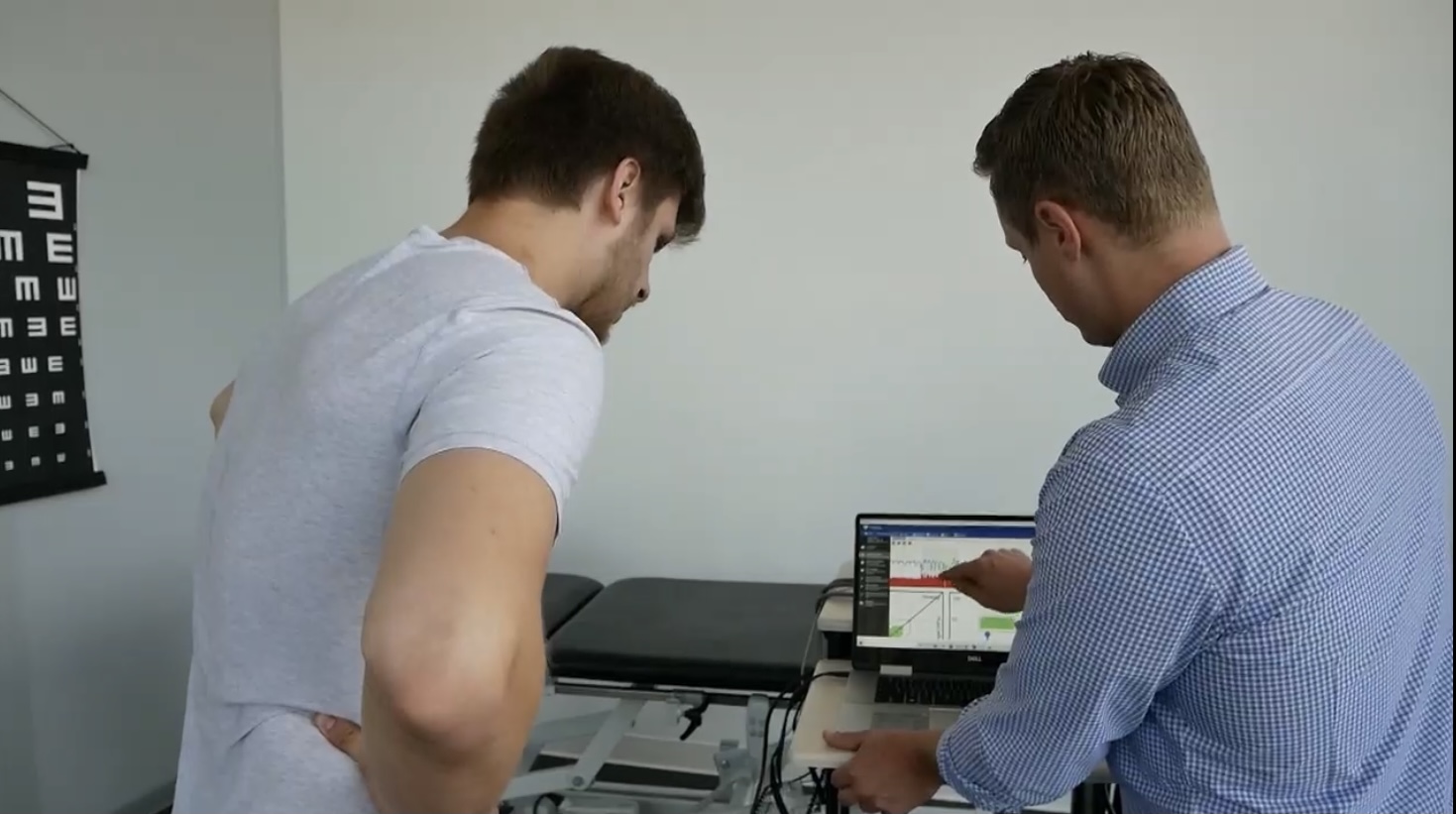
So in follow-up to our last video where we talked about this case where this young lady had had a POTS diagnosis for two years and we were able to do some kind of unique diagnostic testing and determined that she had a change in cerebral blood flow — blood flow to her brain — that allowed us to figure out a different treatment solution so that we could solve the problem. And she actually recovered within a month of doing that type of neural rehab.
So the question then becomes: what did you do? What is the actual nuts and bolts of how did you make it from symptoms for this long to feeling better in a month? That's a reasonable question.
It's kind of a little bit hazardous to answer because these are complex cases. They're obviously complex or it wouldn't take two years to solve them. And the tendency would be to take what I'm about to say and turn that into a template to apply to everyone that has POTS or certain types of symptoms. And my hope is that we don't do that. What I'm trying to convey here is that through a different way of thinking, we're able to give a different perspective on how to solve these types of problems. So rather than giving you a template or a recipe, what I want to talk about is the thought process that we can go through to figure these types of cases out.
What the Blood Flow Testing Showed
So if we start from that little bit of knowledge we have: through the left side of the middle cerebral artery using transcranial Doppler ultrasound, we were able to measure that when she moved from laying down at 0 degrees and then we move her up to 70 degrees of tilt — kind of mimics standing, but it's standing without the benefit of having the ability to move or create a muscle pump through your legs, things that would normally create assistance for returning blood to the heart and then giving blood flow to the brain.
We want to look at taking all of those variables out. How well does the brain do at controlling the cardiovascular system to be able to keep blood flowing to the brain without having to rely on other strategies?
When we look at cases that have orthostatic intolerance — they don't tolerate standing up, POTS being kind of chief among them — we see that when they stand up, we see the tachycardia because it's an adaptation to try to solve for the fact that we're not getting blood flow to the head.
Interesting part about this case: when we do 0 to 70, laying down to standing up, we see a drop of blood flow that is more on the left side than on the right side. That is helpful. Number one, because it means that when she's laying down, she feels relatively fine. Which would suggest that if cerebral blood flow is the culprit, then cerebral blood flow when she's laying down is fine, but when she stands up, that's when things fail and then she experiences symptoms from that.
Finding Functional Proxies
So the way that we think about that is: if we're losing blood supply or we're getting ischemic on that side of the brain and we're getting symptoms associated with that, are there other things, other functions that are associated with that territory that we might be able to use as proxies to make sure that when we measure that decrease in blood flow, we're actually measuring the thing that's causing a lot of the symptoms?
There were two things in this case that kind of stood out.
Number one: when she was seated, when we would do visual pursuit testing — this is where we have someone follow a target, usually the simple thing is "look at my thumb" and follow a target in different directions — we should be able to see that their eyes stay locked on that target wherever it goes. Like a cat watching the canary in the bird cage, right? They should be able to do that smoothly in horizontal, vertical, and in both diagonals.
We found she wasn't able to do that. She had these really jumpy pursuits where it's almost like her eyes couldn't keep up with the target. The target would move and they'd have to catch up. Target would move, they'd have to catch up. So we call these catch-up saccades — errors in pursuits.
Now if we take her and move her down into a supine position, we actually see that those eye movements get smoother. So there's a difference between being supine, laying down, versus being upright in this condition.
Sensory Changes That Come and Go
Number two: we do sensory testing. We take a pin wheel — these little sharp needle-like projections on it — and rub that on your skin. It feels sharp, prickly. That tests one type of small sensory fiber. Then we look at vibration, light touch, and we can see if the sensory nerve from the body is able to project and land where it's supposed to in the brain.
For her, when we lay her down and we measure all of the different modalities on the sensory system — face, arms, trunk, legs — everything's symmetrical. Same on both sides. Then when she sits up and especially when she stands up, we start to notice she gets less sensation on the right side of her body. These little patches where she doesn't feel it. The pin wheel feels smooth. The vibration doesn't feel as intense as it does on the other side.
We know the right side of the body — its nerves travel up, cross over into the left side of the brain into the somatosensory cortex, which is also in this parietal area. So from that information we can say: we're seeing these changes not just in the blood flow itself, but also in the function of these systems. When she lays down, they operate OK. When she stands up, they don't function as well. They become these neurological proxies or functional proxies to what we're seeing with blood flow.
The Retinal Slip Concept
So we take that question: how do we transition her from being able to lay down doing OK, to standing up and still being OK, to sustaining that blood flow?
Number one comes back to the idea of the pursuit. So if we go a little bit deeper — and I think it's valuable so stay with me — there's a really great book, The Neurology of Eye Movements, published by Leigh and Zee, several editions now. What we learn about is there's a little bit more nuance to how these pursuits work, and it's this idea of retinal slip.
What that means is: if you can imagine looking through binoculars — you're watching a bird, you're looking at a deer, maybe you're watching a football game, whatever — if you're following something that's moving through that tube, our eye can sense when we're getting toward the edge of that binocular and we have to adjust to stay on the target. If whatever we're looking at can move faster than we can keep up with, we have to jerk and try to find that target again.
This mimics what we see with those catch-up pursuits. The ability to detect the slip on the retina is going to help us determine how accurate the eye is going to be in tracking the target. So a pursuit has to have accurate retinal slip to maintain the target.
What's interesting is there's another system that also has to use a retinal slip to detect its accuracy. If I look into the camera and I turn my head, I have this vestibularly based mechanism — a vestibular ocular reflex. It's a little bit different in that this one is a reflex whereas a pursuit is something you have to do on purpose, volitionally. But this reflex is kind of like the foundation of what later becomes a pursuit.
"This retinal slip idea is really central to our ability to navigate around in the world — to be able to have a moving body that can tolerate a moving world."
Using VOR Exercises to Drive Blood Flow
So from a rehab perspective, what we want to think about is: can we train that visual pursuit or that retinal slip mechanism so that we can translate it back to a standing posture?
When we do a VOR or a head thrust, we are activating that retinal slip mechanism which is going to have a parietal distribution of activity. Meaning when we move our head and we control that with our eyes, we get activation within that hemisphere of our brain. If we do movements that are to the right, they are going to be more directed toward pursuits that happen on the left side.
So if we're thinking about increasing blood flow to the left side, what kinds of things would cause increases of blood flow into the brain? The one and only is neural activity. When we have neuron metabolism, that is what drives blood flow to the brain. If we increase the neural metabolism from cells in that territory, we have to increase blood flow velocity in order to meet that metabolic need.
"If we pair those things together and say: can I do exercises that activate that retinal slip mechanism so I get that parietal firing through both the vestibular system, through my eyes moving, through my neck moving — these things all fire into this parietal area — then I'm going to increase blood flow into that area."
Why Positioning Matters
So the next question you have to think about is: do you want to sit them up and practice that exercise? Well, maybe not — because in that position, we already know that there's a decreased blood flow, we already have a failing adaptation in that seated position.
If I want to exercise those cells, if I want to make them work harder, putting them in a reduced blood flow scenario is probably not going to be their most advantageous position to start from. If I want to work those cells, I want to give them the best probability of getting blood flow so that I can work them and make them healthy.
Remember, these are not healthy cells. These are sick cells. If they're sick, then we have to be able to treat them a little more gently than if they were strong and robust and really active.
So in this case, we actually lay her back down on her back where we know that blood flow is more stable, more reliable. And then we do the exercise while she is laying down. That allows us to stimulate that mechanism so she's able to have that accurate pursuit.
Finding the Inflection Point
One of the things we don't pay attention to thinking about a tilt test is we go from 0 to 70 degrees, right? We're measuring to full upright. The thing we don't do is we don't measure at what point someone starts to fail. Is it at 70 degrees? Maybe they start to fail at 60 degrees, 50 degrees, 40 degrees. Where's the point?
So that's the next thing we want to measure — what we call the point of decomposition. Where does the adaptability to tolerate orthostasis start to decompose?
The way we do that is we take the same tilt test but break it down and move someone in five-degree increments. Start at 0, 5, 10, 15, 20 — you know the drill. As we move up, we're looking at the same markers and looking at that blood flow to see what is the point at which we see a spike where the blood flow drops significantly.
We do that not only to get a baseline, but we do that individually throughout each session that we treat someone. Because it may change and fluctuate based on their tolerance level at that given moment — how much they slept, how hard we've worked, if they've just eaten or not. So there are a lot of different variables.
Each session we will find that point. 30 degrees — that's where it fails this time. And then we take them just below that to where they can recover. It starts to fail at 30, we bring them down to 25, and we see the system is able to tolerate 25. Now we've created this tension where we can do the exercise, challenge the system, and challenge the orthostasis at the same time.
Adding Peripheral Nerve Stimulation
Then we would think about: are there other things we can do to add another layer of challenge? You might think about this like if you were learning to play a musical instrument. Like, first you're just learning — if you're playing the recorder. My son is in third grade. He's learning how to play a recorder. Super fun time at our house right now.
Anyway, if you're learning how to play the recorder, first thing is to figure out how do you blow in it? Then where do you put your fingers? Then can you do both of those things and move your fingers around to make the sounds you want to make. You add these layers of complexity.
In this case, we know one of the soft spots in this system is that we lose that sensory distribution on that side. So what we chose to do was also use peripheral nerve stimulation. Using an electrical nerve stimulator, we would look at which areas became patchy and stimulate the peripheral nerve associated with that area. In doing so, we're increasing the sensory barrage to that portion of the parietal lobe.
If I stimulate my median nerve, for example — median nerve kind of comes up through here and innervates this portion of the hand — if I stimulate that portion, it's going to go to the hand part of that parietal lobe on the other side. And if I stimulate those neurons, they are going to request more blood flow into that area.
Now the caveat is we can't just arbitrarily stimulate these nerves and send blood flow to the area. We have to do it within a constraint. We don't want to stimulate a nerve that is already not sending appropriate sensory information. If I take a nerve that's numb and then juice it and give it more input, I'm already exceeding the capacity of the brain to feel that area even just sitting ambiently. So if I add more to it, all I'm doing is pouring salt in the wound. The caveat is that when we're doing the VOR exercise and we want to add the peripheral stimulation, we have to make sure that sensory system is already operating effectively before we put weight onto the bar. And that's super important. We check it every time.
How It All Comes Together
So those things — using the VOR to translate into pursuit, using tilt angle, looking for the inflection point of when we actually start to lose the cerebral blood flow, and then looking at peripheral nerve stimulation — that is the mechanism we used to consistently bring up that elevation so that we could elevate her in space without losing sensory perception, without losing the visual pursuit, and without losing cerebral blood flow.
That's when you see sleep get better, symptoms start to go away, and on and on you go. The objective measures that we're taking as we're walking through the treatment are translating into a better symptomatic experience.
And then from there, our job is to keep adding in layers of challenge that approximate the things she's trying to do in her life. Adding exertion, adding mental tasking, prolonging the endurance so she can do it for 10 minutes and then 20 minutes and then 30 minutes and then an hour and then two hours and a full day. You see the strategy here.
At each segment we're making sure we are pushing it, we're challenging that system, but we're not overdoing it to where we're creating a deficit or causing an injury. Same way you would bench press, bench press, bench press until you fail and then go away, sleep, eat, do all the things. Come back next week, try to do it a little bit heavier. The benefit of working with brains is that the half-life of that response is much quicker. So we can get them back quicker and get them under tension quicker and get them moving faster.
Dealing with POTS That Won't Resolve?
If you've had POTS for months or years and standard treatments aren't getting you where you need to be, a free consultation call can help determine whether our diagnostic and treatment approach fits your situation.
I'm Ready to Get Better