I've got another POTS case for you guys and I'm hoping it'll be really helpful for those of you that have been struggling with this particular type. Obviously we know that there can be several different ways this gets diagnosed. We want to actually take it a step further where we're not even thinking about POTS as a diagnosis really at all — we want to think about the mechanism behind it.
The Backstory
This is a 21-year-old college student, male. Chief complaint is a diagnosis of POTS given by the cardiologist. Symptoms had been going on for about a year.
This is a bummer of a case because just the sweetest kid you can imagine. He's an athlete in college, he's a high-performing kid, and then kind of gets worked down or whittled down to the point where he's not able to even continue with school, not able to play sports, not able to exercise. Those of you that exercise and are used to playing sports — getting that taken away and not being able to do it is just super, super tough on morale, right?
You got a kid who's 21, goes from being able to do anything in the world to can't even drive. Can't even take himself to the grocery store. Has someone take him to it and can't even go in the grocery store. You guys have all heard this story a million times. He is one of them.
The Timeline
Going back — broken arm, got a little boxing match and then got a hole in the eardrum. COVID test positive. Mono in 2022. Head injury, didn't see a doctor, possible concussion. And then we started to notice in October, November that year, one of the things that was kind of key that he noticed was while driving, felt like he was going to pass out. He noticed that it happened a few times.
That's about the time he started to notice symptoms were really starting to be a drag on him. Felt like passing out, a lot of chest pain, palpitations, feeling dizzy, off balance, short of breath — especially when working out. Then October, symptoms were getting worse, had to go to the ER. Saw a cardiologist, had an echo, stress test, Holter monitor — no findings. Which is great, we don't particularly like to see problems in the structure of the heart. We like that it's working well. But he also noted that when they were waiting for him, they kind of held him for a little while because heart rate was so high they wanted to see it come down.
November, symptoms are still getting worse. He's lost weight, 10 to 15 pounds. Heart rate's going up when he's standing. Starting to notice the blood is pooling — and when he says that, he's noticing it in two ways: the color change in his skin, particularly in the feet and hands, and he's also noticing like red mottling and some cyanosis, some purpling. And then he's noticing he feels swollen in his hands and in his feet.
He hadn't had a true workout since August and then decided at that point to just stop trying to work out at all because the symptoms were so bad.
Why "Just Exercise" Misses the Point
"Most of them are normal, active, youngish people that deteriorate — whether it's quickly or over time — to the point where they can't be active anymore and they start to get deconditioned. But the point is, the onset was not as though they just like stopped moving and then got deconditioned and then that's how they got here. The symptoms get bad enough it prevents you from moving in the first place."
That's really important because it means we have to think about — we have to use a little more nuance in our thought about how do we rehab people back. If it was just a matter of physical conditioning and like is your cardiovascular system up to snuff, people like this wouldn't get POTS in the first place, you understand? So that to me is really important. It kind of grinds me a little bit sometimes because it's just not a nuanced way of thinking about it and it seems flippant to just tell people who have been slogging to get through the day to be like, "you know what you should do is just work out harder, and here's a way to do it laying down." There's a place for it and it has a utility, but it's just so basic that it doesn't really serve people the way that we can serve them if we think about it with a little more nuance.
December rolls around, new cardiologist, symptoms are getting worse still, and now we're noticing muscle twitching throughout the body and ER visit because heart rate slammed up high. By February, we're seeing a slight fever, more pressure in the head, noticing the blood pooling much more, really cold hands and feet. This is the first time he noticed he's not sweating as much. By April, we've lost about 20 pounds. The symptoms are there sitting or standing. And now we're starting to see visual disturbance.
You can see over the course of this year things steadily deteriorating. By this point — multiple specialists, couple ER visits, cardiologist, neurologist, rheumatologist, psychiatrist, and no real way to move the needle.
What We Found on Exam
So we do our exam and our team notices a couple things that are kind of key. When we get to measuring the peripheral nerves — the nerves that go through the body — one of the things we pick up is that his sensory nerves are kind of divided into two parts. We've got large diameter ones and small diameter ones. The large diameter ones are a little more robust, they've got some myelin around them, they transmit vibration, position of your joints, more proprioceptive aspects. And then we've got smaller ones that are typically type-C fibers and they transmit information like pain and temperature changes.
The interesting thing about looking at the type-C fibers is they're skinny, they don't have much myelin on them, but they resemble what we see with autonomic nerves as well. And autonomic nerves don't really have a sensory component — they're all motor. The sensory fibers are the ones that go from the body, signal from a receptor to the brain. The motor fibers are the ones that go from the brain and go out to do something, to have an action in the body. The difference here is when we look at the sensory fibers, they're the same size, same amount of myelination as the autonomic fibers which are motor — which is really helpful.
In this case, what we saw was this patchy distribution that was pretty global throughout his whole body where he couldn't really sense pinpricks. We use a pinwheel or little pins and we should be able to feel them really easily, but in his case, no. Same thing with temperature — we particularly noticed that in the lower extremities, in the legs, temperature sensation was really poor. And then also the sense of vibration in his knees, ankles, toes on both sides was really, really diminished from normal. Especially for a 21-year-old kid.
So that means something, right? We've got this sensory system where we're seeing these nerves are not working. There's a neuropathy. Not normal for a kid. He's not obese, he doesn't have diabetes. We can see some history of different types of infections which can cause neuropathies.
Venous Pooling — Even Laying Down
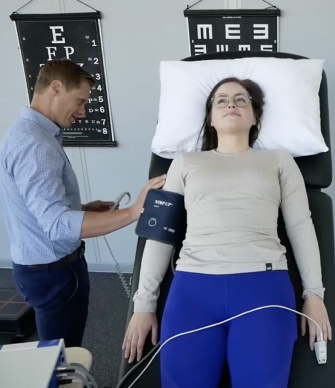
In addition to that, when we have him lay down, we can see a pretty significant — like a profound amount — of venous pooling in his head when he lays down. What I mean by that is when you lay down, it evens out the supply of blood so your heart is not having to work as hard to pump it to your head. It shouldn't have to work that hard to return it back to your heart. But it also shouldn't cause any major changes to the veins.
What we saw were these big expansions of the veins in his head. He's laying down and we see these big veins start to form in his head around his ears and we see the jugular pulses start to become really bounding. That's really helpful because it teaches us a little bit about — man, why are those veins pooling so much with gravity dependence? When he's standing up we're getting a lot of that drainage into his legs and his hands. When he lays down we're getting it into his head. Normally these vessels are tightly controlled so the pressure is really nicely monitored, it keeps it laminar and smooth and going to the right places. And what we're seeing here is just this big pooling sensation.
We also noticed that just putting hands overhead, we get a white hand sign where we see this major loss of color in the hands and it takes a while to return when we bring them back down. He loses his pulses. And then doing a fifth digit test — we have people stick it out and we're testing the strength of the fifth digit in abduction — we see this weak bilaterally. So we know there's also a component of compression happening in that subclavian system.
How We Thought About Treatment
"When we lose our sensory capacity in an area — lose the sensory capacity in my hand — my ability to then shunt blood or control blood to that area is going to have less resolution. It's going to be less precise. And that's what we see in cases like this."
When we're thinking about the venous pooling, when we're thinking about the neuropathic component, our focus kind of turns to — we need to resolve this neuropathy because we're getting pulse rate changes that are compensating for the fact that we had this problem with the peripheral nerves that's causing the pooling.
So what we're looking at is saying: how do we increase that sensory barrage so that we can have better motor control of the autonomic fibers that would serve that tissue and allow us to control the arteries that are underneath that?
What We Used
We used a couple tools that are really helpful. We combine the use of a technology called a Neuro 20 system. It's effectively — I'm going to kind of make it sound simpler than it is — but it's effectively like if you imagine a wet suit but it has electronic stimulus paths throughout that wet suit that allow us to stimulate different patterns within the body. It stimulates the muscles and the skin so that we can stimulate the nerves that are underneath it.
We chose to use that while also doing some active therapeutic work to be able to stimulate those nerves. We also used a peripheral nerve stimulator as well — we could do it kind of in a general segmental bias but then also along each individual nerve themselves. So we did a lot with nerve stimulation.
We started off doing it laying down where he had the best cerebral perfusion and we worked him toward sitting up. Which was the right way to do it. We also noted that on the tilt test his end-tidal CO2 values, his carbon dioxide levels, were lower than they should have been — which is going to cause a vasoconstriction as well in the brain.
We did that pretty doggedly, like very intensely over the course of days, and we worked that really super hard.
The Outcomes
What we found was that he remerged the sensitivity to pinwheel — got those sensations back. Sensation of vibration comes back. Sensation of temperature returned. All in the lower extremities and in the hands, it was really, really good.
We also noticed that we started to see color changes. We didn't have the purple feet up to the shins anymore and we were starting to actually see him turn color — it looked alive. Wasn't, you know, gray like a ghost.
Keeping him in that tight range of being able to control the stimulation through the peripheral nerves, being able to add in some supine light exercise that helps him be able to grade the vasoreactive response — so basically we're training it so that his arterial system gets better at being able to calibrate for the amount of CO2 in the blood. Keeping him in a tight range of just nice easy exercise where he's monitoring it, watching the CO2 levels while he's working, allowed us to be able to start to push him toward exercise. Rather than looking at a heart rate as kind of the way to measure it, we did it with CO2 so that we would be able to stay in the range where the arterial system is going to keep working the right way.
Within the time that he was here, his parents noticed a huge uptick in mood and hopefulness. He also started taking on driving, which is the first time in many, many months that he started to even work on it.
The Two-Month Check-In
We were able to turn that into a home exercise program. After a couple months we got a two-month check-in, and he wrote:
"Been doing very well lately. Been keeping up with my exercises and had some major improvements throughout the summer. I was able to progress to doing upright biking as well as some lightweight training again. I'm also getting prepared to start fall semester in person and going to be coaching a team at the old baseball facility."
So we went from no school, no activity, no workouts to now we're getting back into life. Which to me is just like the whole thing — that's why we do all of it. So I'm super thrilled for him.
He says he feels much more capable doing daily activities again. He's still aware of some eye floaters, he gets a pulsing sensation in his back mainly at night, and he's struggling to put the weight back on, which is expected — we got to build some muscle again. He notices he's more sore than usual, which is obviously going to come with starting to work out again. But he says, "other than that I've been doing great and I've been enjoying life again."
Why We Think About It This Way
We're super pleased with him, super proud of him. He does all the work — we're mostly just giving a framework to work within. But I hope thinking about this in this way is a departure probably from maybe what you've experienced up to this point.
If you're feeling like you're stuck or you're not getting the look that you feel like you should be getting in order to solve the problem, then maybe something like this might be helpful for you. The one we choose to focus on is how do we help the system heal and actually get stronger again in a normal format. So we're not supplementing it with medications and things like that — not to say they're bad. Our bias is that the more we could do it in the way that it was kind of built to work in the first place, hopefully the better probability that that becomes a lasting change over time. That's been our experience, and that's what we're trying to share.
Not Getting Answers for Your POTS?
If you've seen multiple specialists and nothing's moving the needle, a free consultation call can help determine whether our approach fits your situation.
I'm Ready to Get Better