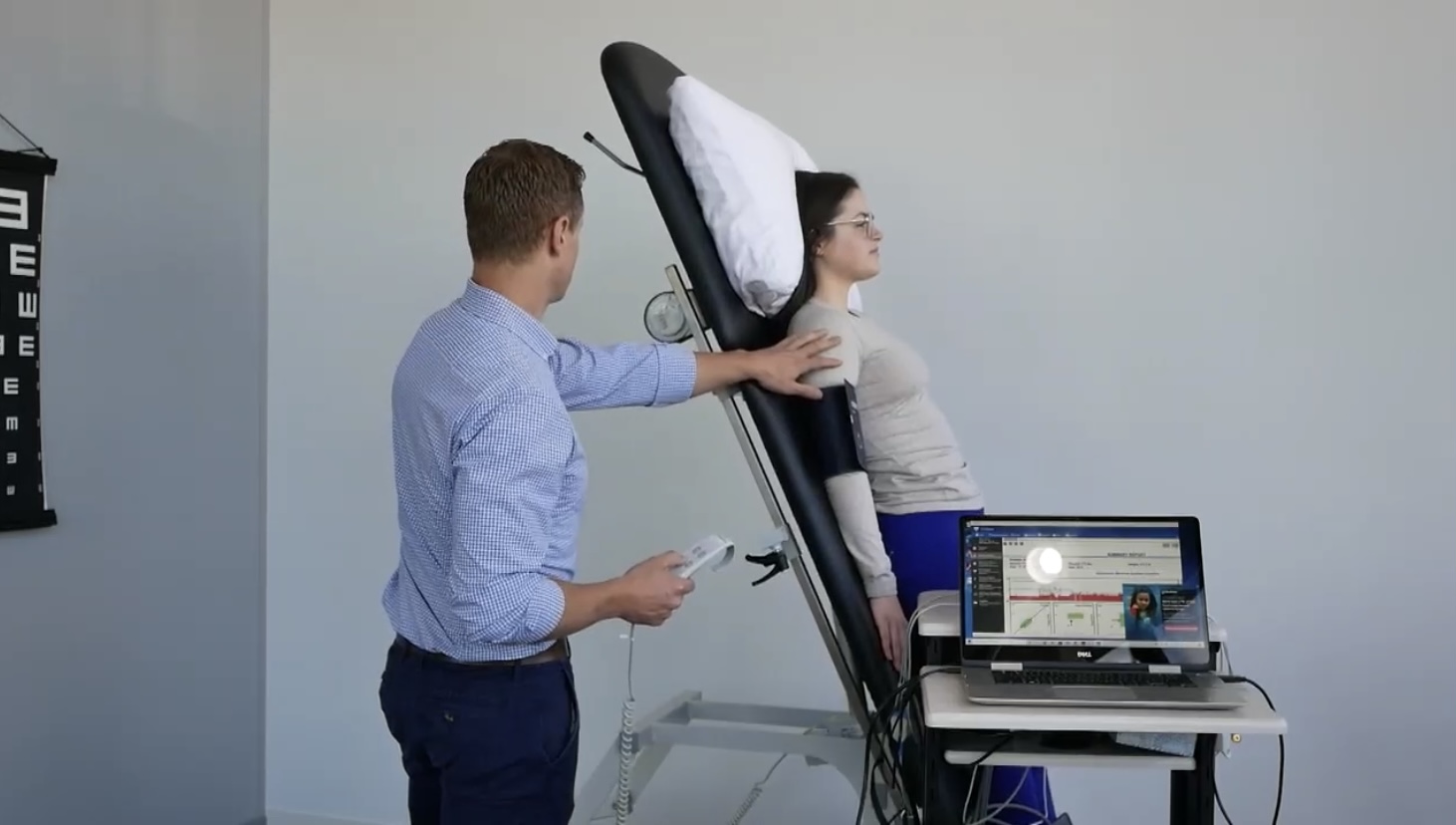
If you've been diagnosed with POTS, you probably know the drill: stand up, heart rate jumps 30+ beats per minute, and you feel terrible. The tilt table test confirmed it. You have POTS.
But here's the question nobody asked: what is your brain actually getting when you stand up?
Heart rate is a downstream response. It's your body's reaction to something. The real question is what's triggering that reaction — and the answer often lies in cerebral blood flow.
The Limitation of Heart Rate Monitoring
Standard POTS evaluation focuses on heart rate and blood pressure. These are important measurements, but they're indirect. They tell you what the cardiovascular system is doing, not what the brain is receiving.
Consider two patients who both have a heart rate increase of 40 bpm on standing:
- Patient A: Heart rate rises because blood pressure drops and the body compensates. Cerebral blood flow decreases by 35%. The brain isn't getting enough blood.
- Patient B: Heart rate rises, but cerebral blood flow actually remains stable. The tachycardia is being driven by something else entirely — a neurological misprocessing of positional information.
Both patients have identical heart rate responses. Both meet POTS criteria. But the mechanism driving their symptoms is completely different, and they need completely different treatment.
Without measuring cerebral blood flow directly, you can't distinguish between them.
What Transcranial Doppler Actually Measures
Transcranial Doppler (TCD) uses ultrasound to measure blood flow velocity through the arteries that supply the brain — primarily the middle cerebral artery. It's non-invasive, painless, and provides continuous real-time data.
What makes it powerful for POTS evaluation is that we can monitor changes second by second as you move from lying down to sitting to standing. We see exactly when blood flow changes, how much it changes, and how quickly (or slowly) your body compensates.
Specifically, we're looking at:
- Baseline cerebral blood flow velocity — is blood flow adequate at rest?
- Orthostatic response — what happens to brain blood flow in the first 30 seconds of standing?
- Autoregulation — does the brain's blood flow self-correct, or does it stay reduced?
- Pulsatility index — is there appropriate resistance in the cerebral vasculature?
What We Commonly Find
In our clinic, transcranial Doppler findings in POTS patients generally fall into several patterns:
Significant Cerebral Hypoperfusion
Some patients show a dramatic drop in cerebral blood flow velocity on standing — 25-40% reductions that persist well beyond the initial positional change. These patients genuinely aren't getting enough blood to the brain, and their symptoms directly correlate with the flow reduction.
Normal Flow with Abnormal Regulation
Other patients maintain adequate average flow, but the regulation is unstable. Blood flow oscillates or shows delayed compensation patterns, suggesting that the autonomic control of cerebral vasculature isn't functioning properly. The brain is getting enough blood overall, but the delivery is erratic.
Preserved Flow Despite Symptoms
Perhaps most importantly, some patients show essentially normal cerebral blood flow despite significant heart rate increases and debilitating symptoms. This tells us the mechanism isn't vascular at all — it's neurological. The brain is misinterpreting positional signals, often through vestibular or cerebellar pathways.
This distinction matters enormously for treatment. If your cerebral blood flow is genuinely dropping, we target vascular regulation. If it's preserved but your brain is misprocessing, we target the neurological pathways that are generating the false alarm. Treating the wrong mechanism is why many POTS patients don't get better.
Why This Isn't Standard Testing
Transcranial Doppler has been used in neurology for decades — for stroke assessment, vasospasm monitoring, and research. But it hasn't been widely adopted in POTS evaluation for a few reasons:
- It requires specialized equipment and training to perform accurately
- Standard POTS protocols were developed around heart rate and blood pressure, and clinical guidelines haven't caught up
- Most POTS treatment focuses on the blood volume hypothesis, which doesn't require cerebral flow data
The result is that millions of POTS patients receive treatment targeted at blood volume without anyone ever checking whether blood flow to the brain is actually the problem.
How This Changes Treatment
When we know your cerebral blood flow pattern, treatment becomes specific rather than generic:
- If flow drops significantly, we focus on neurovascular regulation — improving the brain's ability to maintain its own blood supply during positional changes
- If flow is preserved but regulation is unstable, we target autonomic calibration through vestibular and proprioceptive rehabilitation
- If flow is normal but symptoms persist, we look at neurological processing — often finding vestibular or cerebellar dysfunction that's generating inappropriate autonomic responses
This is why two patients with the same POTS diagnosis can receive very different treatment plans at our clinic — and why both can improve when previous approaches failed.
Still Symptomatic Despite POTS Treatment?
If standard POTS management isn't resolving your symptoms, the mechanism may not be what you've been told. A free consultation call can help determine whether our approach fits your situation.
I'm Ready to Get Better