Most people start off their conversation about POTS thinking about the circulatory system from the fact that they have blood pooling in their extremities. Most people experience that. They know it. Medical terms, it's called acrocyanosis. But what if I told you that we should actually be paying attention to the part of the circulatory system that is on completely the other end?
We can think about the circulatory system, blood flowing through the body in two main ways. Number one, we have systemic circulation. That's what we're talking about when we think about blood pooling. But then number two, we have cerebral perfusion. And that is the second circulatory system that no one talks about. We should actually be talking about it very first visit, the first conversation we have.
Your Worst Symptoms Point to the Brain
So, most people with POTS will recognize that the symptoms can be distributed all over the place. But most people wouldn't say — usually when we say like, "What's the worst thing you're going through?" — most of them won't say, "Well, the worst thing that I noticed is that my feet are purple or that my legs feel a little bit full." Right? The thing that really tends to bother people the most is that they've got these problems related to their cerebral perfusion. Right? So they have brain fog, they are super fatigued, their vision is blurry, they get dizzy when they stand up, you know, they get changes in their vision, thinking, mood, energy, etc. Right? These are problems that are going to be related more to our ability to get blood flow into the brain than it is relative to blood flow in the legs.
“The blood flow in our brain is controlled completely separately from the blood flow in the systemic circulation.”
Why Brain Blood Flow Has to Be Different
So if you think about it as like, oh well, it's that pooling that causes the problem — there's this really interesting thing that we have to start with as our base knowledge. The blood flow in our brain is controlled completely separately from the blood flow in the systemic circulation. So we can think about systemic blood pressure. That would be like all the blood pressure from like neck down. And then we can think about cerebral pressure or cerebral perfusion. And that's going to be the blood pressure that happens inside of our skull. And they have to be different from the start because the blood flow inside of the skull has limitations.
Your brain is really really fragile, right? The tissue itself. So it can't be fire hosing pressure inside of the brain otherwise we cause damage. It causes swelling, causes stroke, right? Also, we have a blood-brain barrier inside the blood vessels in the brain that allow us to be able to peruse chemistry and nutrients through that system while also keeping a tight regulation so that things that shouldn't get into the brain don't. So, it's this protective layer. So, all of that requires that we can't have our blood pressure get too high in the brain.
Autoregulation: How the Brain Stabilizes Flow
So, there's this really cool thing when you think about this system. It's called autoregulation. Autoregulation is basically this idea that the blood vessels themselves in the brain have their own reflexes that help to dampen or expand blood supply to different neighborhoods or different territories within the brain depending on what is being used. So if I'm using my left hand, the left hand part of my brain is going to get more blood flow, more oxygen so that it can do more work.
This system of being able to stabilize blood pressure in the brain — it works in mean arterial pressures between 60 and 150. So what that means is we can have our blood pressure as low as like 80 over 50 and we should still be able to keep a normal amount of blood flow to the brain. Same thing on the other end. We should have the ability to have really high blood pressure like exercisingly high blood pressure and we still maintain the same amount of blood pressure in the brain.
When Blood Pressure Is Normal But You Still Feel Bad
So that is actually the part that if we've got POTS or if we've got orthostatic hypoperfusion, if we've got any of these tachycardia-based syndromes where our blood pressure stays normal — we have to pay attention here. Because if I've got blood pooling but my blood pressure is normal, that means that my cerebral perfusion should be able to stay normal as long as it's in that band between 60 and 150 in the mean arterial pressure. Right? So our brain should be able to stabilize blood pressures across I'm laying down and resting to I'm sprinting down the street.
And what we find is that if we're dealing with something like POTS as it's diagnosed or where we're having tachycardia relative to being upright, it means that the core feature of the diagnosis is that the blood pressure stays stable. So even though our heart is working hard, the blood pressure is in a normal range. And if it's in a normal range in the systemic circulation, but it's not normal in the brain, we have a problem.
“When we look at pooling in the extremities, we're looking at an effect, not the cause. And if we can just simply switch our brain around to look at it a different way, it opens up a whole new world of possibilities for how to try to solve this problem.”
And what it's telling us is one of two things. Either we have something that is obstructing blood flow to the brain — it's blocking the vasculature from actually delivering blood pressure into the head. Or number two, the reflexes that control that system — autoregulation, baro reflexes, vestibular reflexes, etc. — they are not working to accurately deliver blood to the brain. And that's why this is so important.
Why Medication Doesn't Always Get You Over the Hump
So if you're in a typical scenario where you're trying to manage POTS with a medication, let's say the medications are designed to kind of regulate those vital signs so the heart rate can come down, but we're looking at through the lens of heart rate and blood pressure. And that makes it really easy to understand why I can have my heart rate come down or my blood pressure be stabilized, but I can still be symptomatic because the things that actually are driving the symptoms themselves haven't really changed, right?
So if I go from having a normal blood pressure with a high heart rate and all I do is have a normal blood pressure with a lower heart rate, then the ability to translate that into cerebral perfusion hasn't really changed. I haven't really moved the needle in that way. So that is why for a large population of people they can take the medication, their heart rate comes down, and they may feel like actually some of the symptoms around having a high heart rate — like the palpitations and the anxiousness and feeling like shaky and tremory — some of those things come down because your body's not screaming trying to maintain the blood pressure to keep you upright. So that can make sense for why some people the medication just doesn't quite get them over the hump.
Finding the Cause: Obstruction vs. Reflexes
What do you do with this? Right? So, if I've got these reflexes that are problematic or I've got an obstruction, how do I figure that out? And then what do I do going forward? Well, all the action steps come with knowing what is actually the problem. Without testing it, you can't know if something is obstructing. Like, I've got actual like something in my neck and the bones themselves because they're not oriented correctly are actually choking off the blood flow to my head. Like, that's a useful thing to know.
And it might be that I've got a post-COVID infection and it happened to irritate or affect my blood vessels and the autoregulatory system doesn't work as well. Those are two different things, right? And if I can understand the difference and if I can understand how to treat one versus the other, now we actually have a road to run down in order to try to solve the problem.
How We Test for This
When you go to the cardiologist and the neurologist, they can do things that really help to push you in a general direction, which is great, right? You can do an easy tilt test, you can make sure that there's nothing growing in your brain that shouldn't be there. You can look at your blood values, make sure you're not anemic or you don't have an infection. All those things are great, but then when you get to the point where you've solved for that, then you kind of have to go to the next step deeper.
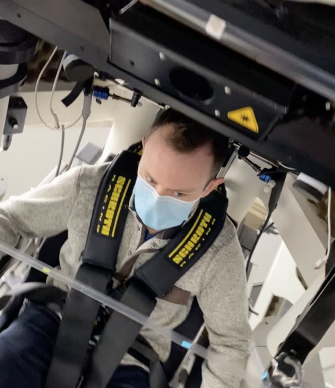
And that's where we want to look at things that help us look at the blood flow to the brain. Transcranial Doppler has been the choice that we've used because of its flexibility and dynamism — meaning we can look at the changes in blood flow that happen when people do different tasks, right? So I can put someone on a tilt table and check the difference between laying down and being upright. We can't do that yet in something like an fMRI, which would be wonderful — we just can't. Magnets are too big.
And then it also lets us do things like turn the head. Many people will notice that if they actually turn their head and hold positions, they can see changes in their symptoms and changes in function because of that. It's really useful to know. And then understanding — is that from my vestibular system, is that from my neck? What is going on here?
“The blood pressure in my body, completely different system than the blood pressure in my brain. And if those two systems are able to work in harmony, everything runs beautifully across all blood pressures, all healthy blood pressures.”
Start Thinking About That Second Circulatory System
So, if you're noticing that you're having pooling or you're having symptoms that look like I'm not getting enough blood flow to my head, start thinking about that second circulatory system. The blood pressure in my body, completely different system than the blood pressure in my brain. And if those two systems are able to work in harmony, everything runs beautifully across all blood pressures, all healthy blood pressures. If those two systems aren't working in harmony, then we will find that even when we were in a nice normal blood pressure range, we're still not able to maintain blood pressure to the brain.
So if you're curious about understanding more, the gold standard for understanding whether or not you're getting enough blood flow to your brain is to look at a transcranial Doppler ultrasound — looking at the blood flow actually into the arteries of the brain and comparing that laying down where things are stable versus being upright. And we like to tilt that on a 70-degree angle. And if you can use that gold standard, you can start to understand if the blood flow in your brain is enough when you're upright.
So, if you're trying to like ask your doctor, that's kind of the test you're looking for. We're looking for a tilt test with transcranial Doppler ultrasound. And if they have that, that's going to be great information for you.
Think Blood Flow Might Be Part of Your Problem?
If you're dealing with brain fog, dizziness, or fatigue and nobody has looked at the blood flow to your brain, a free consultation call can help figure out whether our approach fits your situation.
I'm Ready to Get Better