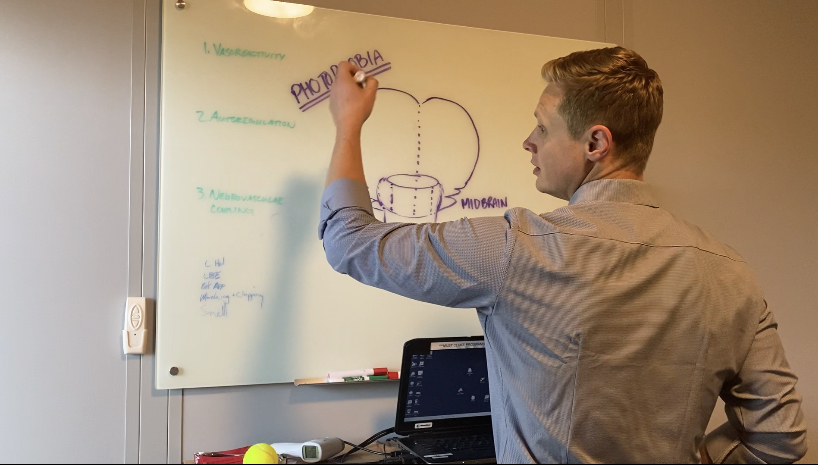
We've had awesome conversations with people in the POTS community, the ME/CFS community, who understand really well how this particular problem — not being able to sustain blood flow into the brain — is hugely detrimental and symptom-causing. But there are two questions that we have to compete with. Number one: how do you get that blood flow back? And number two: what is actually going on underneath this?
So we're going to dive into the baroreceptor system. For some of you that's going to feel a little heavy and sciency, but I promise we'll make it super easy. And if you understand this, it really helps you understand not only what's going on inside of you, but why people are recommending things like medications, compression, and salt — and whether or not any of that is actually useful for you.
The "Blood Pooling" Story Everyone Runs With
We get a lot of comments that talk about blood pooling, right? And the assumption kind of goes like this: the blood must be pooling into the legs, and because it's pooling into the legs it can't get to the heart and it can't get to the brain, and then I feel bad. So all I have to do is figure out how to squish the blood back up and then that solves the whole problem.
And in some degrees that's kind of the basis of the thinking. Like, when people go to the hospital dehydrated and they don't have enough fluid in their body, the amount of blood they have actually goes down. They don't have enough to circulate, they're more likely to faint. So in the hospital we load them up on saline and they feel better because we just rehydrate them — kind of like beef jerky, right? We just give them some more fluid.
So the response to that is like, well maybe at home we can mimic the saline. We can have you drink more salt, do oral hydration, and that kind of makes it so you have a little bit more blood volume for a period of time, and maybe that helps with symptoms. That's the salt idea.
The Midodrine Approach — And Its Problem
Then we go a little deeper and talk about something like the midodrine idea. And that idea is: what we're going to do instead is take all of the blood vessels in your body and just make them super tight. If we make them smaller, it's just like if you put your thumb over the top of a garden hose — it makes it so that the pressure goes up. And if the pressure goes up everywhere, it's going to be forced into the head as well.
But as anybody who's taking midodrine knows, sometimes it makes you feel better, sometimes it doesn't. And it also means you don't get to control your blood pressure anymore. You have the same pressure whether you're standing up and your heart has to push upwards, or if you're laying down and your heart doesn't have to push against gravity. So it's almost like the blood gets rocket-boosted into your head, which is kind of maybe not a good thing either.
Why We Need This System: We Walk on Two Legs
So what's at the core of this is a simple reflex, but it's the reflex that makes us stand out amongst anything else on the planet. Because we walk on two legs. Because we walk on two legs, our heart is below our head, which means you have to have some extra sensors. You have to have a little bit different computer that helps us know when our head is above our heart, because we've got to kick in some different strategies. Different reflexes that help push blood up into the head.
The simple way we talk about this is we use the term baroreceptor system. "Baro" means pressure. "Receptor" is just a type of sensor. And when I say "system," it means we're talking about from the actual receptor itself all the way through the mechanism that controls blood pressure.
The Tire Pressure Analogy
If you drive, if you have a car, you might notice that modern cars will give you a little signal on your dashboard if the air in your tires is getting a little bit low. How does that work? Some engineer figured out that if you put a little pressure sensor inside of that tire, then it can detect when the pressure is lower. It sends a little signal through a wire up to a little microchip computer in your car. That computer gets signaled, gets the switch flipped, and turns on a light — ding — on your dashboard. That light is supposed to signal to you as the motor system, the thing that does stuff, to go put more air in that tire. You do, the pressure sensor turns off, sends a signal up the wire, turns the light off, and everything is happy. Right?
That's what happens with the pressure receptors throughout your body. The two biggest ones, the main ones, happen to live right here in your neck and they're called the carotid baroreceptors. They're on the road to your head, and every single heartbeat — in milliseconds — they're running that reflex.
How it works in real time: When you lean forward and tie your shoes, more blood rushes to your head because it's below your heart. How do you keep from just blowing your head up every time you bend forward? The pressure sensor detects more pressure and your brain decreases the amount of blood flow into the brain. It restricts against that. And when you lay down, the opposite happens — it's super easy to pump blood to your head, so your heart rate comes down, blood pressure comes down a little, cerebral vessels normalize. Nice and easy.
The Gap Nobody Is Measuring
One of the interesting things we find is that when people do testing for things like POTS or ME/CFS, they measure two main features: your heart rate and your blood pressure. Sometimes they even forget to do blood pressure. But that's also how they check for midodrine responses — they look at your blood pressure and assume that if your blood pressure is normal, then the blood flow going to your head is also normal.
What we have found — and other people have found as well — is that just because you have a normal blood pressure in your body doesn't mean that normal blood pressure is being transferred into your head.
The reason is really simple. Blood pressure in your body can be dynamic. It can be absorbed by your skin, which is stretchy. So if my blood pressure goes up, I have plenty of room to expand that and circulate blood faster, which is really good for replenishing muscles if I'm working hard. But your brain doesn't have that benefit, because it's locked inside of a skull. Push too much blood pressure in and it's just like when you bend forward — too much pressure in your head, starts to damage stuff. That's intracranial hypertension territory.
So the blood vessels in your brain do a really good job of restricting when pressure is too high and dilating when pressure is too low. But that response is separate from what happens neck-down. Different responses.
Normal Blood Pressure, Not Enough Brain Blood Flow
Most of the people that we see are somehow, in some way, diagnosed with POTS. Whether it's right or not doesn't really matter. What that means is their heart rate is going up and their blood pressure is relatively stable. But what we measure with transcranial Doppler is that even in the environment of a normal blood pressure, we see changes in cerebral perfusion where we're getting not enough brain blood flow.
So then you have to ask: how does that make sense? If the blood flow in my body is normal, why isn't that going into my brain?
And that therein lies the problem.
This is where those baroreceptor systems become super important. If you can't detect that blood flow going into your brain properly, then you become what's called pressure passive. And what that means is the amount of blood that goes to your brain is fully dependent on your heart and gravity, and the reflexes that would normally allow you to maintain a really stable blood pressure in your head fail.
A quote from Johns Hopkins published on their site says: "In people with POTS, for unclear reasons that may differ from person to person, the blood vessels don't respond efficiently to the signal to tighten. As a result, the longer you're upright, the more blood pools in the lower half of your body."
That's kind of the general structure people operate on when they think about POTS. And it makes sense if you don't think about it real hard. OK, I stand up, blood doesn't do as well coming up to my brain, pools in my legs. But then you run into something: in a POTS diagnosis we also have normal blood pressure. So if someone has normal blood pressure but all of the blood volume has supposedly dissipated down into their splanchnic arteries and legs — why is it that they can still get it into their arms?
That becomes a really core question. It forces you to separate blood flow to the head and blood flow through the body as two separate mechanisms that interact beautifully.
Where in the System Is It Breaking Down?
So if you feel like this is the state you're in, let's think about it using that tire pressure analogy again. If we're finding that the tire keeps going low but you're not getting the signal — you get out of the car and you're like, man, why is this tire always flat? — something is wrong in the system. Here's what a mechanic would check:
- Is the sensor rusted? Is it not working? It's not getting the sensation. That would be like the actual baroreceptors themselves or the arteries not being able to detect the change.
- Is there a problem with the wire going into the computer? These are nerves — like the glossopharyngeal nerve coming from the baroreceptor to the brain. So we check the nerves, what's going on there, how they correlate with other functions.
- Is the computer corrupting the signal? Maybe the nerve is fine, but in the brain it's not being processed well. This is super common with people who've had viruses or concussions or anything that has affected the function of their brain — little pockets where it just doesn't work as well, can't generate as much output, can't detect that change properly.
- Is the dashboard light out? Everything works, but the light that tells you to go put air in the tire is burned out. You never get the signal.
- Is the motor output the problem? The whole thing could work really great and you are just lazy and you don't get out and put air in the tire. That would be a problem with the motor output — we're not generating enough signal.
Those things are all a little bit abstract, but those are the things that someone who's trained will look at to determine where in that system it's not working — and then develop an action plan to start solving for it.
Where to Start
At home, the best place to start is: what does my blood pressure look like relative to my symptoms in my brain, especially when I'm standing up? Is my blood pressure actually kind of normal but I'm still having symptoms of hypoperfusion — still operating like I'm not getting blood flow to my brain? That's a really good starting place.
And then from there you go, OK, but how do I fix it? That part is a little more nuanced. It's a little harder to DIY. But probably getting someone on your team that understands that nuance is going to be really useful, because you're going to shortcut through a lot of trial and error and actually understand what problem you're trying to solve.
Ready to find answers?
Talk to Dr. Keiser directly about your symptoms.
Schedule a Free ConsultationConcerned About Your Brain's Blood Flow?
If you suspect your symptoms are driven by reduced blood flow to the brain, a free consultation call can help determine whether our testing approach fits your situation.
I'm Ready to Get Better