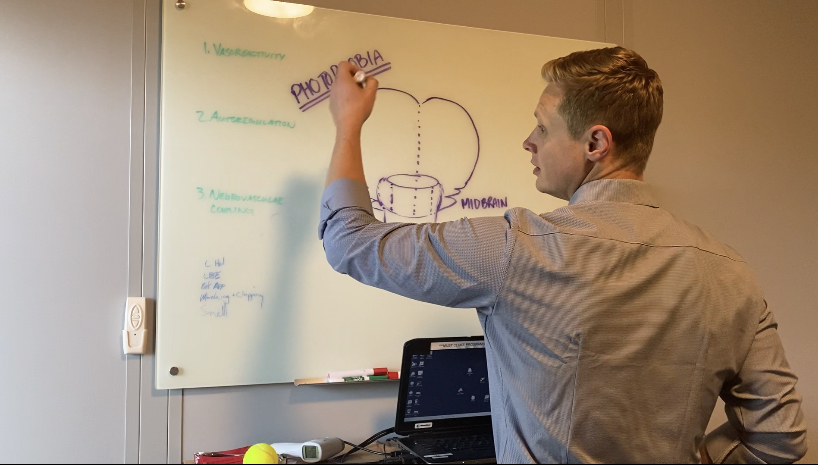
Today we've got a little bit of a special treat for everyone. We are with Dr. Claire Keiser. She's kind of like the magic behind the whole clinic, because the team of people, the people that you'll talk to in the onboarding process — like when people call in to figure out, "Are you guys going to be useful for me? Tell us your story. Tell us everything that's going on, what's the medical history" — all that process is done with Dr. Claire. And it's really helpful because she's actually on the front end. So most of the stories that we hear for the very first time, I'm not hearing them. She's hearing them.
So what we thought we'd do today is maybe bridge a little bit of that gap and talk about some of the big questions that people will ask in those initial conversations. That way you might have a little more sense of us before you even reach out, which I think is always a good thing.
How Is This Different from PT, OT, or Vision Therapy?
A lot of patients call in and they have been to many, many doctors, many therapeutic approaches. Big question we get is: what makes us different when you think of PT, when you think of OT, when you think of vision therapy, vestibular therapy — how are we different?
So first of all, I would start by saying I think each of those different modalities, each of those different disciplines, is wonderfully useful for a whole load of different people. Where the game shifts a little bit for the people that come to see us is usually they've seen a number of those people — maybe multiple in one discipline, or maybe all of them across the board.
And when you think about it, so you go to the PT — most of that training is in kind of orthopedic specialty. Your mind is thinking about, it's visualizing the muscles and the ligaments and the bones and how they're moving and working together, right? If you're a vestibular therapist, your kind of algorithm is around this balance system and how can we kind of prevent the symptom of dizziness, and how do we think about balance as a core structure. And then you go to vision therapy and we're mostly looking at the orientation of the eyes and specific things related to the vision. Or occupational therapy, doing specific tasks. And on you go, right?
But I would say that the reason that all of those different disciplines can be successful is ultimately based on the effect that each of those stimuli has on the brain. So if you think about coordination from a PT level, right — you're thinking about muscles and getting them stronger, but what you're really doing is getting your brain to be able to coordinate them better, to be able to control them better so that they don't exceed limits of stability. And these are all things that rely on the nervous system in order to be able to achieve them.
“Rather than look at them in those individual silos, I think the differentiator for us is that we're starting at the brain and then we're tracking what's going on with people.”
So rather than look at them in those individual silos, I think the differentiator for us is that we're starting at the brain and then we're tracking what's going on with people. This is what functional neurology is all about. What are we observing, and how does it relate — not to just each one of these different systems individually, but how are they all relating to each other as well? And how does that come back to the brain? Because we can use that to figure out how are we going to leverage the sensory input, the processing within the brain, or the motor outputs to close this loop — to allow that system to run cleaner.
I would say that the main difference is not in the tools that we're using, because a lot of times we will be using a lot of the same tools, similar ideas, similar approaches, maybe even similar exercises. But because we're thinking about what is the effect it's having in the brain — not so much thinking about what is happening in that local tissue — we're using whatever that exercise or that task is, we're trying to actually use that to talk to the brain. We're trying to control the brain through that exercise. We're trying to teach the brain through that exercise. And I think that's the main difference in what we're thinking about.
For People Exhausted by Doctor Visits
Number one, I think most people, if you're in the position where you have now gone outside of like, "I just trust my GP, right? They'll go there, they'll figure out what the heck's wrong with me, and then I'll just be done." That is the first step for most people and it's what they should do. It's what everybody should do because that's the easiest thing. It's the thing you have the best access to, least amount of friction, best way to go.
But as you go from like GP to specialist number one through 30, and you kind of keep hearing the same thing where it's like, "We don't necessarily know," or "We're going to try all these different tests" and then they don't yield an outcome — all of these things lead to like, they kind of get your hopes up, like "Maybe I'm over it now," and then there's a letdown. And then there's a hopes up and then a letdown. And you can only fall in love and be let down so many times before you start to get a little bit discouraged, or you might even think like, "Maybe none of this is going to work," or "Maybe it's in my head."
So I do think that discouragement is a big part of the game for a lot of people. And people deal with that differently. Some people you can't rattle them. They are optimistic. You won't discourage them. They're going to be fine. Keep hustling no matter what. And then some people are going to be more easily discouraged.
But what I would say is that number one, if you're watching a video like this, you're probably the kind of person that is willing to keep looking, keep hunting. And as long as you don't stop or you don't quit, eventually that path will lead you to something that will be useful. And I think that there's just a certain type of person that is able to pursue that better than others. And those are the ones that tend to find us. And they also tend to then be the type of people that can do well because they can stay with it — they can do the stuff we're trying to do.
Why POTS and Dysautonomia Cases Get Dismissed
We see a lot of POTS, dysautonomia, post-concussive cases. Why do so many of them get dismissed by traditional medicine? Well, I don't think they're intentionally dismissed. I think it's part of the incentives of how traditional medicine works. I mean, you think about it a couple ways.
Number one, the person that you're seeing probably has a waiting room full of people that they're trying to get to, that they're trying to rush to get done, because at the end of the day, that waiting room is gonna be full again tomorrow and the next day and the next day and the next day, and you're just like trying to plow through that. So that's number one — the incentives aren't great to like really stop and be able to try to figure it out.
“When you're an expert at something, you kind of assume you're great at it. And if you don't know what the answer is, then nobody else is going to either.”
But then number two, I think there are a lot of people in the specialty that are considered experts but may not feel well-versed in these different types of conditions. And because of that, when you're an expert at something, you kind of assume you're great at it. And if you don't know what the answer is, then nobody else is going to either. And so then it's kind of easy to just be like, "Well, you know, go try this thing or try this medication, or maybe I'll get you over to this department." It's one of the main reasons dysautonomia treatments fail — the underlying problem was never identified in the first place.
Or the classic one is to just be "psyched" — which is where it's just like, "I don't know what it is. It must be a psychological thing. Let's get you over to psych, find you some sweet meds, and then on your way — you're out of my hair." So unfortunately, I do think that that happens. I don't think that that is the intention. I think that's just like the best strategy they have to solve the problem. And maybe the actual assumption is that nobody else has a different idea on how to solve it.
But generally speaking, I think that's what makes people feel unseen, unheard, and then also kind of stuck. They don't know where to go. Because once you've been kind of put in that bucket, it doesn't feel like there are a lot of options presented to you at that point. And now you become your own advocate. Now you got to go hunt stuff down, which also feels really big. That's probably why people watch the videos — because you're trying to basically figure out what your doctor who spent a ton of time learning doesn't know. And a lot of people do that, which is amazing.
Why Clean Labs Don't Tell the Whole Story
A lot of these conditions, when you're going through that traditional western medicine approach, you will get a lot of imaging done. You will get a lot of blood work done. And you know, nine times out of 10 it comes back clean. Great news — but also frustrating at the same time, because where are my symptoms coming from? They don't see a picture of it. Image looks great, blood work looks great, or something is very minor.
So once you observe like the things that I have at my disposal — which in a modern era is you're going to get blood work and you're going to get some type of imaging — for most people it's not a particularly hands-on type of an evaluation. And I think that's very different from what we do.
Because we're saying, nine times out of 10 there isn't anything on the MRI. CTs came back clear. Blood work's pretty good. So we're using like actual old school physical observation, bedside examination, hands-on autonomic testing, listening to your heart, watching the way your eyes move, watching the way your limbs move, asking you questions — like hunting.
And I think that that part, just nobody does it anymore. But I think that's where a ton of magic is. Because if you're just looking through that screen, you can't see somebody in a screen. That blood work only tells you so much. That image is a moment in time in a certain position, and we're looking for the worst stuff, but it doesn't tell you about the things that are preventing them from being able to do their day — because you can't see it in that screen.
“You got to look at a person. And you got to see their body. You got to watch the way they breathe, the way they react to questions. When do they start to slur? When do their eyes start to droop? When do their pupils start to change?”
You got to look at a person. And you got to see their body. You got to watch the way they breathe, the way they react to questions. When do they start to slur? When do their eyes start to droop? When do their pupils start to change? When does their posture shift? All of these things. And that creates a much more rich clinical picture.
Why We Don't Do Telemedicine
I get criticized all the time because I don't take telemedicine appointments. And I mean, it would make my life way easier if we did telemedicine. That's the reality. We could go live on the beach and I could just park in front of a big screen, but that's not the reality.
And the reason I don't is because of everything that you gather being in a room with someone — even if it's having my team in the room with someone, and then I'm learning through them, and then being able to check in. All of those things matter. But I think the best work is when we are making sure that there's one person's sensors that are picking up on another's. That sounds a little esoteric, but I do think it really matters.
Feel Like Something Is Being Missed?
If your labs look clean but you still feel awful, and nobody has done a real hands-on evaluation of what your brain is actually doing, a free consultation call can help figure out whether our approach fits your situation.
I'm Ready to Get Better