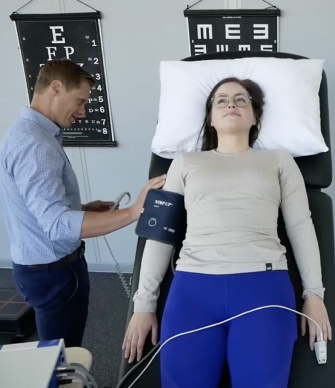
Even though the symptom you feel is "my heart is racing, it makes me anxious, I'm getting lightheaded" — we have to step back and think about what that heart is actually trying to do.
In POTS — postural orthostatic tachycardia — that word "postural" is pretty important. It means there's a difference between what's happening when you're laying down and when you're upright. So what's going on when you're upright?
Standing up is a unique challenge to the body. You have to be able to still deliver blood flow against gravity.
The Penthouse Analogy
OK so imagine you're in a skyscraper. Tall building. You live in the penthouse. Super sweet, great windows, nice view. Beautiful. In order to get anything up to the penthouse, you need to use the elevator. And that elevator requires energy — like a motor — to push people up to the top floor.
Now, people that live on the ground floor? That doesn't require much energy from the elevator system at all. Pretty easy. You don't have to run any of the machinery, any of the control systems, none of the people sitting in the room with the little computers making sure everything's OK. None of that.
But if you're going up to the penthouse, now we have to involve some machinery. We've got to know that there's someone in the elevator. We've got to know where they're trying to go. And we've got to know how much force we need to push that elevator up to the top floor.
And that's kind of how it is when we think about delivering blood flow to the brain when you're standing up.
What Actually Happens When You Stand Up
So when you move from laying down to upright, there's going to be a shift where the blood flow — the elevators — is trying to drop down against gravity. That's just the way gravity works. But if we want to resist that, we've got to activate the machinery. We've got to know that we need to change it, and then we have to match the amount of energy from that machine to adequately get the elevator up — so we don't shoot it through the roof, but we also don't end up on the third floor instead of the 50th.
That takes a little bit of nuance. It takes control systems.
We have different sensors — nerve receptors — that help us to understand: hey, number one, we're moving. Number two, it feels like we're starting to get a little bit of drop in the pressure up in the neck, the heart, the lungs, and that may be problematic for getting blood to the brain. So let's kick on the elevators. Let's kick on the heart. Let's kick on the blood vessels and push more blood up.
Where It Goes Wrong
The issue is that even though you might know you're standing up intuitively, the reflexes or sensors that are in charge of closing that circuit and making blood flow arrive correctly may be too slow to respond. Maybe they're not sensitive enough. Or it might be that some portion of the system is too sensitive and gives an overshoot error.
The main areas we think about here are what are called baroreceptors. These are pressure receptors inside the blood vessels in a couple key places. The big ones are in the neck, the heart, and the lungs — they help keep that pressure stable.
On top of that, we also have pressure sensors that line the entire endothelial system within the blood vessels, which is pretty cool. Endothelial just means the inside of the tube. So every heartbeat, that tube — the arteries — can respond to changes in blood flow. If you're running and blood pressure goes high, it might knock the pressure down a bit so you don't shoot through the roof, right? If you're relaxing and upright and maybe a little tired, it might drop down and the system needs to constrict to keep blood flow high enough so levels don't drop too low.
Simple concept. But it is one that is not well paid attention to.
What Most Doctors Are Measuring (And What They're Not)
A lot of people will say, "I went to the cardiologist. I went to the neurologist and we did a makeshift tilt test." Whatever that means — maybe they laid down, stood up. Maybe they sat then stood up. Maybe they just eyeballed it. Maybe there was even a full tilt test.
But very infrequently are people getting tests where we're actually looking at the blood flow in the brain. And then even less frequently than that are we boiling down to see why those changes are happening.
- Is it in the baroreceptor system?
- Is something getting blocked in the arterial system going up — like a compression on one of the arteries in the neck that prevents blood flow in certain positions?
- Could it be that blood flow can't drain properly out of the head, putting the brain under more pressure so it has to decrease the input?
Lots of different things can happen. And we can get into the nuance of those things on a person-by-person basis.
The key insight: We spend a ton of time just trying to artificially drop the blood pressure using chemistry, using medication. We spend a lot of time trying to artificially constrict blood vessels using medication, using chemistry, using compression. But a different way to think about it — maybe even alongside those things — is: why aren't you getting the right signal in the first place? And what can you do to train your body to be more sensitive to it again?
These Reflexes Are Trainable
When I say "train it" — these reflexes are things we have from the time we're babies, right? So the idea that we would just lose them and they go away is a little foreign. Instead, we want to think about how to get somebody stronger, how to get more sensitive to those signals again.
Think about somebody that's weight training. They're trying to make their muscles more responsive to a weight stimulus. How do you do that? You increase a little bit of weight over time so the load gets higher. The challenge gets higher.
Now here's the thing to consider. If when you stand up, your system is not responsive — that weight, that barbell, is too heavy. Your body's not responding to that dose effectively. So we have to take some of the weight off the barbell.
It means we have to find the place where your system can actually be responsive and start where it can achieve the goal, then work back up from there.
That sounds simplified, and it kind of is. But what we're aiming toward is: can we get the receptor to send the right signal to the brain, the brain can interpret it effectively, and then it does the right thing on the back end? Maybe that starts out at a very small challenge level. You're not standing up. You're not running around yet. That's OK. But if you take that and turn it into a little bit more difficult, and a little bit more difficult — next thing you know we're sitting up. Next thing you know we're able to start moving around. We're able to think more, use our brain without it wearing out. And then just keep scaling in that direction.
Tachycardia Is Not the Devil of the Problem
So the main idea is this: we want to start shifting this idea of tachycardia away from it being the devil of the problem and start to figure out if there's something more behind it. Is there something hidden? Is it that we're starving the brain? That's a great place to start.
And the beauty of the whole thing is that if you're in this scenario, there may be an opportunity to look into — hey, how are those systems working? Can I measure it? And can that give me an opportunity for a positive outcome where I can actually get myself out of these symptoms? That's why we're talking about it. That's why we spend the time.
Ready to find answers?
Talk to Dr. Keiser directly about your symptoms.
Schedule a Free ConsultationReady to Find What's Driving Your Tachycardia?
If your heart rate keeps spiking and nobody has explained why, a free consultation call can help determine whether our diagnostic approach fits your situation.
I'm Ready to Get Better