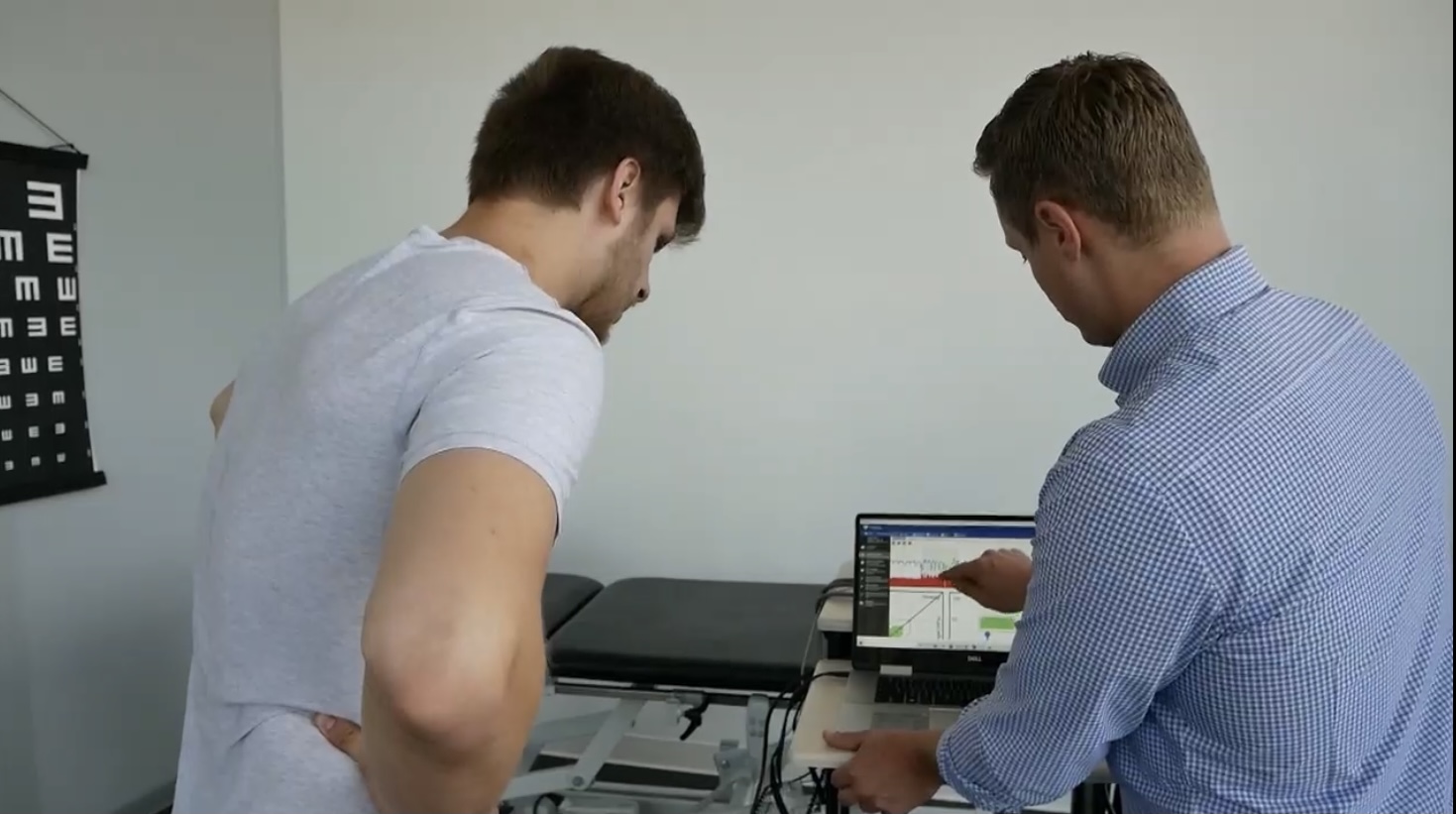
So what we kind of did is took a very quick snapshot of a tilt test. Quick snapshot of a 10-day-later tilt test. A lot of people that deal with these particular problems are young and so they're still managing a school life, which I think is wonderful. But there's a lot of angst about like, am I going to be able to go to school? And so this is the time of year where we're digging in — especially our college students are kind of already there and running and we get to see that reflection of the summer and where they're at. And it's really cool to be able to see them kind of taking on school and taking on that challenge.
On the symptom side, it's the stuff you're used to hearing, right? Lightheaded, a lot of shortness of breath — big time shortness of breath — getting some PVCs, super uncomfortable. PVCs are premature ventricular contractions, so it's actually a heart rhythm problem too. In addition to having a POTS diagnosis, also have this arrhythmia that comes in and it feels like skipped beats, super uncomfortable. And it also contributes to feeling lightheaded because as you skip some beats, obviously you're not pumping blood during that time.
What the Tilt Test Actually Looks Like
So this is a really good simple snapshot that's easy to show of what that tilt test is going to look like. You can see this light part — this is what we do in the test where we just have you lay there for a little bit. Just get acclimated. We want to see just what life is like. And then this is the tilt portion. 70 degrees of a tilt. So it's like standing and laying at the same time. And we measure these out through the minutes.
Now, you can see in this first one, we only made it to eight. So we got an eight-minute standing count. And then we had to throw in the towel. We've got some heart rate data, we've got some blood pressure stuff, capnography — just think about this like the breathing section. And then the next part is the left and the right transcranial Doppler. That's just looking at blood flow that's coming in to the left side of the brain, right side of the brain through the middle cerebral artery.
Where I Actually Start: The Blood Flow Region
Where I actually usually start these conversations is in the blood flow region. Why? Because what does it take to get blood into your head? Well, good question. Glad you asked. You have to have a certain amount of blood pressure. If you can't generate blood pressure, the only way that you can get it into your head is to tip you upside down and hope that we can drain it into your head, right? So if you're going to get blood going upwards, we've got to have some pressure. And then how do we manage that? We manage that by constricting blood vessels. And we manage that by altering our heart rate and how strong the contraction is.
So what we're looking at is real simply — these are our baseline mean numbers. These are great. 71, 74, rocking along. Laying down is crushing. And then what we're looking for in that next minute is we want it to be as close to this number as possible. Why? Because all the cool stuff humans do is when we're moving and not slithering around. We wouldn't need arms and legs if that were the case. We walk on two feet. That means you got to be able to push blood upward.
When One Side Drops and the Other Doesn't
So we want this number to be at least 90%. This one on the left side crushes that — 94-ish percent. But then we go over to the right side. Boom. 45.9%. So we'll round up, 46%. That's not great. That means we're losing quite a bit of that initial flow, especially on that right side of the brain. In that very first minute, we get a big drop. And we also see this pulsatility index that's really high, which means there's a lot of resistance to flow on this side that there isn't on the left side. And that matters a whole bunch.
By minute two we want to see — OK, can we at least hold it at 85%? Crushing it on the left side. Right side, we've recovered a ton, which is great. Not quite all the way home but big recovery. We like it a lot. And then as we track that down, we want the rest of these to be 85. We did that really, really nicely. But over on the right, you can see we're hovering around that 85-86 mark. And eventually after a dual-tasking moment — doing the math in your head, count backwards by sevens — we just couldn't handle it anymore. Had to come down.
"It's not just big drops bilateral, away we go. Here's a little bit different because we're seeing that there's this kind of one-sidedness to it. This right side is affected differently than the left. And then we can see that temporally it changes."
And then we can come back and look at the end-tidal carbon dioxide because for every millimeter of mercury we're dropping there, we're going to drop about 3 percentage points in blood flow. We can see that's pretty reasonable. We're low for sure, we're too low, we don't want to be there, but we're not to the point where we should be seeing this kind of drastic drop on the front side. And then you slide back over and you say — did the blood pressure drop? What happened? And we can see that it didn't. It rose the way it should. So that's good news. And then the heart rate just cranked. We went from 77 to 143, adjusted back down to 123, then down to 97, back up to 115, 99.
The Neck Component
So then we look from there and we sit up. We put her in a chair, still got the Doppler on. And we're going to look at if we're seeing changes with head movement. So we're going to have them turn and hold their head to both sides, flex their head down, tip their head back, stick their chin out, pull their chin back, tilt to the lateral sides.
One of the things that we can't know is when we do that, if there's a problem, we don't know if the turning — that problem is coming because they've got a vestibular problem, or the brain just doesn't know how to do a turn very well and drops the flow, or if there's a problem in the neck and we actually restrict flow somewhere in the course from the heart to the head.
So the way that we differentiate that is we do what's called a cervical torsion test where we hold the head and then we're just going to turn the body underneath the head and keep the head still. When we do that, the vestibular system and the ocular system is not moving. It's not active. So we're just straining the neck.
And we're looking for 20% or bigger changes. Right rotation — turning to the right — decreases flow rates to the left side by at least 20%. Left rotation does the opposite, decreases the right side. Flexion decreased the left side. Extension decreased the left side. Right lateral flexion decreases the left side. And then with the cervical torsion, turning to the right decreased the left side and turning to the left decreased the right side. So we see that there's this kind of like something's up with these head turn components because these are messing with her too. And that's really important because that's also part of this shift between laying down and standing up — the loading of the head on the body.
And it turns out also that we could kind of get a yield on being able to instigate those PVCs by doing head turns. I can listen to her heart, have her move her head, and you hear the arrhythmias come in.
The 10-Day Retest
OK so this is the post one. First thing that jumps out at you — we made it 10 minutes. So there's a big win. That's pretty fun. This is 10 days later. That's not very long when you've been dealing with this for a long period of time, right?
So 10 days later, working hard, and primarily working on things that revolve around this neck of hers and the stability of being able to control it, as well as just the simple structural posture underneath that. And those of you that are laughing because I'm a chiropractor talking about necks, I get it. But in this particular case, that's where we're at — we're thinking about her neck.
Just rerunning the test, you can actually see the mean values are lower, but they're still in a really beautiful range. And then you see these nice responses where we're not having that big latency drop. Numbers are all in the 90s and hundreds, which is wonderful. We've clipped up these ETCO2 scores a little bit. They're not cranked all the way up yet, but we're seeing them start to trend up. And then we're happier with the blood pressure. And then you can see we're still having some of this spike, but we're like 20 points less on a spike, which is cool. So even though we're still getting some of that, it's coming down, which is really cool after 10 days.
And then you can see here in all the ranges of motion, she cleaned them all up, which is crazy. All of these were roughing it. And then she didn't pop any positives on the second time around. Huge win.
"I don't want to show you these to be like, look at how amazing it is. What I want to show you is what it actually looks like in a real person — this is what they go through."
What Happens After the Blood Flow Comes Back
So I get this conversation a lot, which is — OK, I got the blood flow back in my head, I should be rocking and rolling now. And it's like, well, kind of, but also you've got to get that blood flow in your head and you've got to let it heal. So there's an amount of healing that has been compromised along the way that needs to come back in, and then some integrity built out in this system again to actually make it stronger.
Step one is like normalize it so that you can just get oxygen and glucose and all of the chemistry that you need back into the brain so that you can start to build the strength back in. And I think that part's super important to kind of keep in mind — that's the first step. We got to get it there and then we can start to get stronger after that.
Because at this moment we're riding high. We're really hopeful. But then there's this part that's like — I feel all the feels because this is happening. But then we get into the feels of like, man, I'm turning over the reins. I don't get to control this perfectly when they go home because it's in her hands. She gets to be the one that decides to do these things every day. She's the one that's got to stick with it. I'm giving it up, which I don't love doing, but that's part of the gig.
So there's a little bit of wait and see. A little bit of, OK, where are we going to stumble? Can we make the habits? Can we get them to stick? Can we see where the weak spots are going to be?
Some of them are miracles, some of them slog, right? But that's the nature of it. But it really speaks to the importance of what we primarily worked on here — this cervical component and the fact that we actually had this cervicogenic nystagmus. So we had to do things that were structural, to be able to have it so that she could shoot the blood into her head, but then also be able to recognize where her head is through that central vestibular system.
My perception from where I sit is that there are a ton of people walking around with pictures that look just like this because I see them constantly. But because this isn't on the forefront of what people talk about, they just don't even know to look at it. And nothing that you're going to do from a chemistry standpoint or your diet — those things are all great for general health — but that's not going to solve this particular problem. So I just want to bring attention to that.
Want to Know What Your Tilt Test Should Actually Show?
If your tilt test only looked at heart rate and blood pressure, you may be missing the most important piece. A free consultation call can help figure out if a deeper look fits your situation.
I'm Ready to Get Better