If I had a diagnosis of ME/CFS or a chronic condition, I would for sure be scouring the internet trying to find someone that could give me the step-by-step solution to fix that thing. I get it. But here's the problem we run into: ME/CFS is a diagnosis that's based on symptoms. It's a name for how you feel. And because of that, it doesn't actually tell us what the source is.
That muddies the waters when you're trying to figure out what problem you're actually solving.
So ME/CFS is really great as a way to communicate how you feel. But in terms of getting you to a position where you can solve the problem, we've got to look a little bit deeper.
Same Diagnosis, Three Completely Different Problems
What I want to show you is three real cases of people who all had a diagnosis of ME/CFS. They all generally had a pretty similar symptom set. But when we actually dive in deeper, all three of them were dealing with completely different problems. And because of that, we had to implement completely different treatments for each of them.
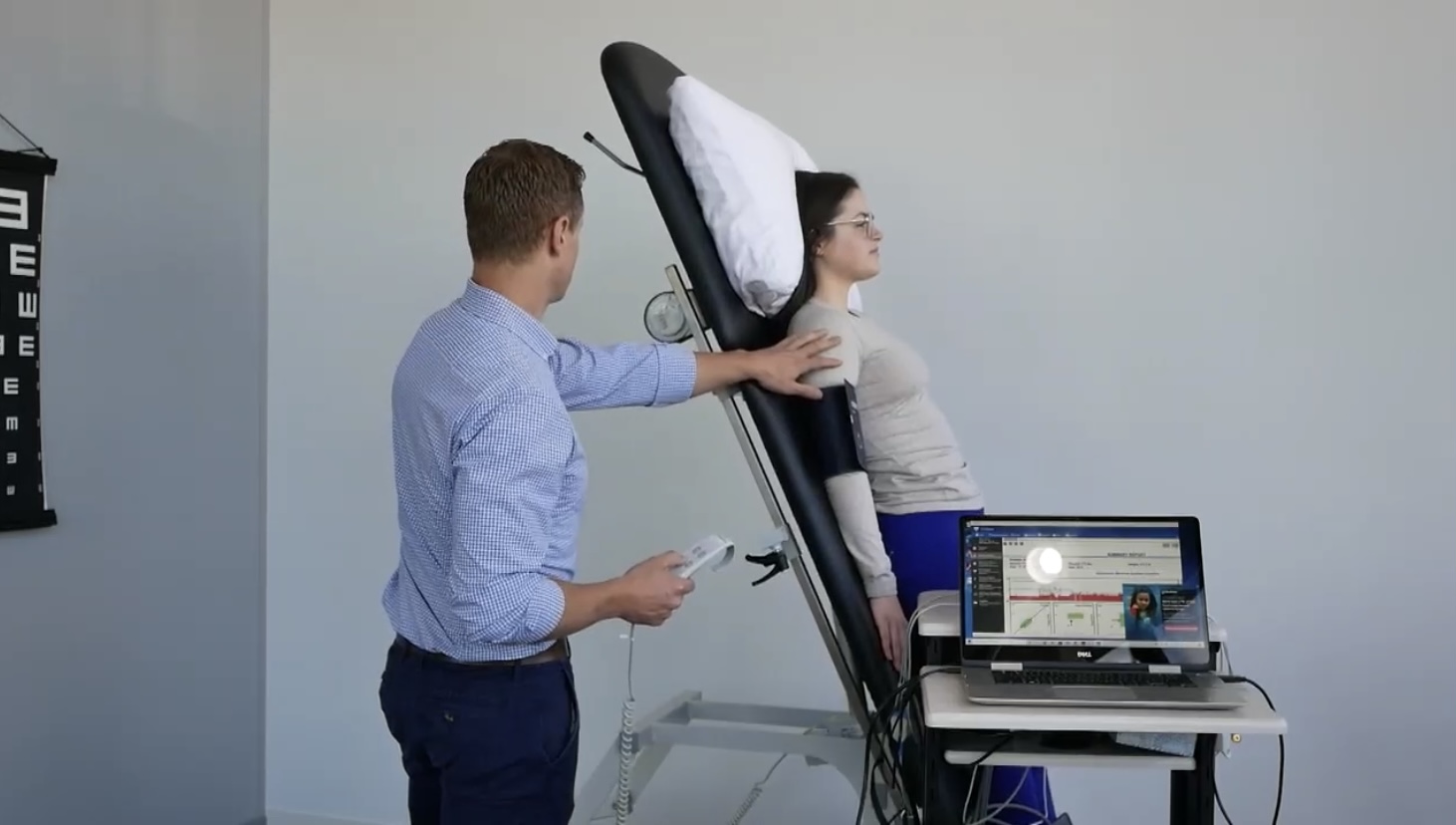
Each of these three cases had workups that involved a tilt test looking at cerebral blood flow — the way blood flows to the brain when they move and change positions. And here's what's interesting: even though all three come from different mechanisms, in each of them the amount of cerebral blood flow lost on a tilt was significant. These are all people where, when they go upright, blood flow just drops out of their brain.
But then we have to figure out — well, why is that? It's not just the magic ME/CFS thing. It is a thing that is happening. So what's causing it?
Case 1: Hemi Neglect — When Half Your Body Goes Missing
Hemi neglect. Hemi is half, right? And neglect is not aware of it. You leave it alone.
So this person had an injury from a car accident — think of it like a concussion. And a long time goes by and she's just languishing in the symptoms you'd normally expect. Fatigue, a lot of joint pain, a lot of lightheadedness, just not able to get up with any oomph. Breathing problems, shortness of breath, and general exertional malaise. She comes in with a walker, exhausted. Uses a wheelchair a lot of the time.
But what we found was that when you actually try to get a sense of how her system works — she only feels things on half of her body. If you run a tissue down one arm versus the other, the left side of her body doesn't really feel anything. It feels almost foreign. Same with pain, pinprick, temperature — all muted on that side. Vision, balance — she tips over to that side. The whole left side, from face all the way down to leg.
Now, we want to make sure that's not just from not getting enough blood flow to the head. So we check upright, then we lay her down where gravity can deliver blood to the brain. Does it get better? In these cases, it won't. And that's what happened here. Even laying down, same thing.
Where does hemi neglect come from? When you damage a part of the brain on the right-hand side, all the information from the left side of your body gets processed there. If that processor can't do the job because it's been injured, you don't get a good interpretation of that part of your body. And then everything you try to do can have an error.
Think about it from a symptom basis. If you don't feel one side very well, it's really hard to move it. It's like if it was asleep all the time — really hard to control. The amount of tension in the muscles changes, you put different demands on the joints, and there's a likelihood you're going to experience more pain, more inflammatory load, deteriorating joint quality throughout the system. Especially the spine and the neck.
One of the paradoxes of hemi neglect is that because you don't feel all the normal stuff as well, you actually become more sensitive to pain. This is old stuff — people talking about phantom limb syndrome. If I lose a limb but still feel pain in it, it's because my brain is processing pain since we don't have the normal responses. Same kind of idea here.
And then the third piece: if you don't have good control or good feeling of that system, you're going to be much less precise in the way you distribute blood. More likely to create pooling into those large venous pools on that side because you're not generating as much return. And that's where we see that drift into hypoperfusion in the brain.
Treatment for This Case
Because of where she doesn't feel her body, we needed to remap that in her brain. One tool we used was a simple square-wave E-stim system meant to simulate the signals that would come from your muscles and talk to your brain. We do that without moving someone. Gently through different nerves — the median nerve, the peroneal tibial nerve in the legs, the radial nerve in the upper arm. We move through the system trying to map out very distinctly where each nerve is so we can light up that area in the brain.
Do I know what my finger is? If I can know what my finger is, then maybe I can know what my hand is, then my arm. And then moving forward from there.
We also used mirror imaging — take a mirror, cover the weak side. When she looks into it, she sees the reflection of the good side. So we can do things with the good side and let her observe the weak side as though it's working normally. You're basically tricking the brain into feeling like those limbs are moving using the visual system. It's like a step below actually moving the limb, but it helps us get to that point.
Then small head turns to the left side to control and map out where her head is in space. Sounds super small, super boring, and kind of lame, but it was actually one of the biggest benefits she saw. As she could control that discipline of knowing where her head was in space, we saw a really nice acceleration in being able to get up and start moving around.
And then we got into the fun stuff. Reaction time testing, walking more, actual physical exercise — when before that was a no-go. "I'll be down for 3 days. I don't want to waste three days." She eventually made it all the way around the block without crashing the next day. Which was awesome.
Cool things came after that you wouldn't normally think are related. Breathing problems went away. She was having asthmatic-type symptoms, but there was nothing wrong with the lungs. She was having blotchy skin reactions to food — typically people will lump that in with MCAS, but what we really see is overactivity relative to sympathetic nerve firing. We started to see those things go down. Was able to go on and head back to a normal life.
Case 2: Long COVID — When Blood Vessels Stop Doing Their Job
This is someone who had two vaccines and a booster, then got COVID shortly after. That's when things started going off the rails. Tons of brain fog, a lot of dizziness, and the malaise was pretty profound. No real time out of bed, laying in bed in a dark room, not able to work. Kind of just stuck.
When we look at cerebral blood flow on a tilt, sometimes we see people where the blood flow drops but holds a range. Like, we might want it at 90%, but it holds at 75 solid. In those cases, the brain is using that as the set point. The sensor feedback systems are trying to hold it at that rate. It's too low — that's where the error is — but that's the problem.
This case was different. This was specifically related to the endothelitis she experienced. Infection that goes into the blood vessel and affects the reflexes of how that blood vessel controls blood pressure. It all becomes pressure passive — which means you're completely relying on your heart to do the whole job, when normally the blood vessels in the brain are in charge of distributing blood throughout the system.
So when she tilts upright, the blood falls low. These are significant — we're talking about a 50% change in blood flow when laying down versus standing up. If you cut out 50%, the symptoms are usually pretty profound. That's what she experienced.
Treatment for This Case
Completely different model. We're not trying to solve one problem in the brain the way we were with the first case. We're trying to think about how to stimulate those reflexes in the blood vessels to work better again. How do we retrain them to be the normal amount of responsive? Like a reflex in your arm — there's a Goldilocks principle. Tap the reflex, it should be a little bit active, not too active and not flaccid. Somewhere right in the middle.
She was blessed with a great vestibular system — her ability to detect change in head movement and angulation all works. That's important because on the road to being upright is the ability to feel where your head is relative to your heart. We used vestibular sympathetic reflexes that create an increase in signal to the vessels so they're more likely to contract.
Then we came behind that with simple cycling, but with a specific twist. We monitored CO2 levels — a little cannula around the nose measuring breathing while working out. Because when we see problems with cerebral perfusion, CO2 levels tend to trickle down, and that causes its own problems with vasoreactivity. By keeping people in a tight CO2 range, we know we're maximizing the response from the vascular system without letting them tank themselves or overshoot.
We started laying down. Actually had her on a simple bike, not working very hard. And we tell people: we are doing blood vessel exercise. We're not worried about getting out of breath or getting huge quads. What we're worried about is that every heartbeat, that vessel does exactly what it's supposed to do.
As she responded better on the tilt, we'd gently start tilting her up while she's working out — just a little more challenge to the brain at a time. By linking that back to the vestibular response, the autoregulatory system gets progressively stronger.
She went from losing 50% of cerebral blood flow to being normal. Then able to start doing more things, no recovery crash afterward, sleeping better, and just compounding that until she was able to go back to work and take care of her kids.
Case 3: The Neck — When Joint Errors Choke Off Blood Supply
OK so our third case is what we'd call a cervicogenic case — the problem actually exists in the neck. This is someone in healthcare at a high level who had a whiplash injury. Had to stop working. Was super active before, basically doing nothing now. Bedridden, in the pits, really sad, not knowing what to do with her life.
What we found right away on the tilt test: cerebral blood flow is dropping through the floor. But specifically when she's moving her head, we see these huge drops. Tipping her head back, turning to the left, laterally flexing to the left — all cause significant drops to the point where she feels like she's going to pass out sitting in the chair just holding it for a couple seconds.
So we had to figure out: is this because the joints are messed up from the whiplash and giving such a bad proprioceptive signal that it's making her feel terrible? Or is this related to the actual arterial structure of blood flow going into her head?
We differentiated this using a cervical torsion test with a Doppler — turn her body, keep her head still. That takes the vestibular system out. We can see how much is coming from the neck versus somewhere else. And the same thing persisted when we isolated just the neck movement.
Why blood pressure matters here: The ability to squish an artery is kind of based on how much blood is flowing through it. Think about a soaker hose in your garden — really easy to step on and squish. But a fire hose going full steam? Really hard to compress because the pressure inside is so high. When people have lower blood pressures, those vessels become more compressible. So we keep a special eye out for these cases.
The name is fancy — extra-luminal carotid compression. People usually talk about carotid arteries being blocked from the inside with plaque. That's not this. This is getting pressed on from the outside. When the kinematics of how you move your neck have errors, the vessel has to move more than it should and can get pinched by the hard structures in the bones.
Treatment for This Case
How do we help her move in a way where she's not effectively choking herself? This is where being a chiropractor comes in handy. We gave really light proprioceptive input — just light touch to those joints so they'd start to rotate together the right way. When she tried to move before, they moved in a big block. It's like trying to throw a baseball with your arm all stiff and rigid. Seven vertebrae in your neck all need to move individually to create normal articulation.
First three days, she'd start to tremor and shake and we'd have to give her a break. But that period got a little longer and a little longer. Next thing you know she's able to ride to the clinic without throwing up, which is pretty cool. Then able to be at the clinic talking to people. When you see someone go from sunglasses on, hood up, just trying not to die sitting in a chair — and then after a couple days the glasses are off and they're starting to talk to people in their world. That's a pretty cool thing.
We also used a neck bracing technique to hold her head in position so the other muscles in her thoracic and lumbar spine could get stronger to support that position, then give her the freedom to move her head. Worked down the whole system that way.
Within a couple weeks, she was actually running at the clinic. Bananas. She blew everybody away.
And I'm aware that seems super easy and simple and of course a thousand people should have done it. She had access to literally anyone. But a lot of times in the most complicated cases, it's actually the smallest, simplest inputs that make the biggest difference.
So What Does This Actually Mean for You?
In all three of these cases, the symptoms are relatively the same. There are outlying things that are different for every case. But even if you've got the same diagnosis, a lot of people experience that diagnosis in different ways. If you can relate to any of this, maybe it's worth looking at things a little differently — figuring out what's actually happening with cerebral blood flow in your specific case, and then working from there.
Still Searching for Answers?
If you've been told you have ME/CFS but no one has explained why, a free consultation call can help determine whether our diagnostic approach fits your situation.
I'm Ready to Get Better