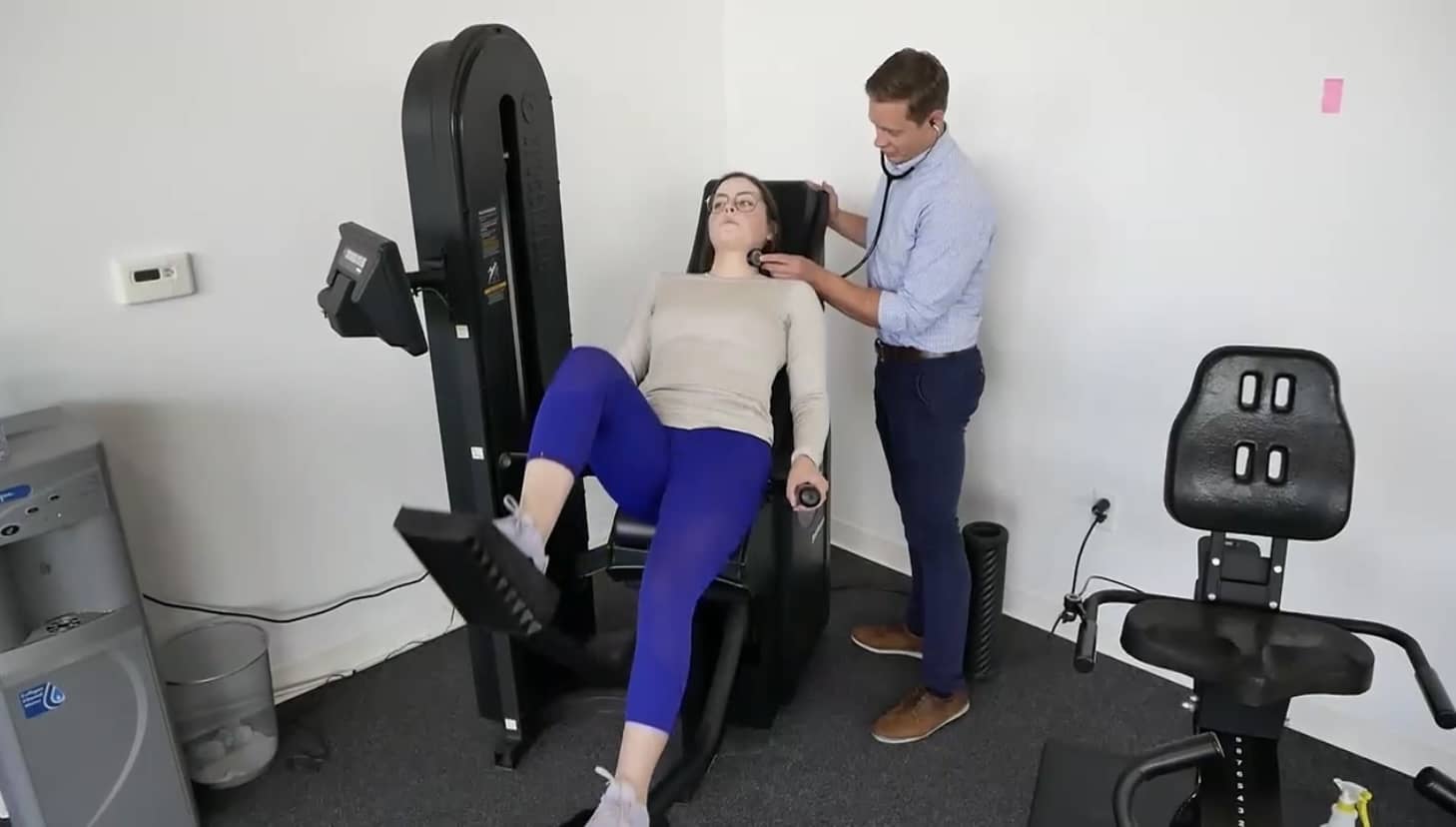
One of the most frustrating things POTS patients hear is some version of "you just need to exercise more." As if they hadn't thought of that. As if the person telling them this has any idea what it actually feels like to try.
I want to walk you through a real patient case that illustrates why exercise intolerance in POTS is not a willpower problem, not a fitness problem, and not something that gets solved by just pushing harder.
What She Told Us
This woman came in with two main complaints: fatigue and exercise intolerance. Not vague complaints either. She had very specific markers for how her life had changed.
She used to walk her kids to the pool in the summer without thinking about it. Now she was getting out of breath just walking them to the bus stop. That's a massive functional decline, and it didn't happen overnight.
She used to do 45-minute exercise classes. Then she could only manage 30 minutes. Then she noticed that even after shorter sessions, she needed to rest for hours afterward just to function. That post-exertional crash kept getting worse until exercise wasn't helping her — it was wrecking the rest of her day.
On top of that, she was working on a master's degree. Her productivity had dropped significantly. Brain fog made it hard to concentrate, hard to process what she was reading, hard to retain information. She couldn't even help her kids with their homework anymore. Not because she didn't know the material — because her brain wouldn't cooperate.
So here's a person who is watching her capacity shrink in every direction. Physical. Cognitive. Parental. Academic. And she's being told to exercise more.
What We Found on Examination
When we actually examined her, the picture started to make a lot more sense than "deconditioning."
Cervical Spine
She had really decreased cervical range of motion. When we test head positions, she couldn't even get into the ranges we wanted. The muscles in her neck were super tight and actively restricting movement. This matters more than most people realize, because the cervical spine is a major player in how the brain receives information about head position and blood flow regulation.
Coordination Deficits
On the right side specifically, she had noticeable coordination problems. During finger-to-nose testing, there were tremors. Her rapid alternating hand movements were floppy and imprecise. These aren't subtle findings — they point directly to cerebellar dysfunction on the right.
Cerebral Blood Flow
When we measured cerebral blood flow during tilt testing, she showed hypoperfusion that was isolated more to the left side. When we tested her in an extension position while sitting, the left side also showed decreased flow. So we had a consistent pattern: the left hemisphere wasn't getting adequate blood supply during positional challenges.
How the Brain and Body Connect Here
OK so this is where it comes together, and this is what gets missed when the only tool in the toolbox is a heart rate monitor.
The right cerebellum talks to the left cerebral cortex. They're functionally paired. So when we see decreased coordination on the right side — pointing to right cerebellar dysfunction — and decreased blood flow on the left, that's not two separate problems. That's one coherent picture. We're starting to see a tie-in between the two.
The left cerebral cortex maps the right side of the body. Sensory information from the right side crosses over to be processed on the left. Motor programs generated on the left cross back to execute movement on the right. When the left cortex is hypoperfused — when it's not getting enough blood — everything it controls takes a hit. Coordination. Motor planning. Cognitive processing.
And the cerebellum doesn't just coordinate movement. It's involved in autonomic regulation, timing, cognitive processing, and — critically — the brain's ability to predict and prepare for the physiological demands of exercise.
Why deconditioning protocols fail many POTS patients: Graded exercise programs assume the body's response to exercise is a conditioning problem. But if the brain can't properly regulate blood flow during position changes and exertion — if the cerebellar and cortical systems that manage autonomic responses are dysfunctional — then pushing harder doesn't build fitness. It overwhelms a system that's already failing to keep up. The patient isn't deconditioned because they stopped exercising. They stopped exercising because their brain can't support it.
Why "Just Exercise More" Doesn't Work
The standard advice for POTS patients is graded exercise. Start with recumbent exercise, slowly build up, increase duration and intensity over weeks and months. The underlying assumption is that deconditioning is either causing or significantly contributing to the problem, and reconditioning will fix it.
For some patients, this helps to a degree. But for many — far too many — it either doesn't work or makes things actively worse. And the reason is straightforward: the problem isn't the muscles. The problem is the brain's control of the autonomic system.
When you exercise, your brain has to do an enormous amount of regulatory work. It has to redistribute blood flow, adjust heart rate and vascular tone, manage blood pressure during positional changes, regulate breathing, and coordinate all of this in real time. That requires intact cerebellar function, adequate cerebral blood flow, and proper integration of sensory and motor systems.
If any of those systems are compromised — if the cerebellum isn't coordinating properly, if cerebral blood flow drops when it shouldn't, if cervical dysfunction is feeding the brain bad information about head position — then exercise becomes a stress the brain can't manage. Not a stress the body can't manage. The muscles are fine. The cardiovascular system is capable. But the brain's control system is the bottleneck.
That's why this patient could do 45 minutes, then 30, then needed hours to recover. Her body wasn't getting weaker. Her brain's ability to regulate the demands of exercise was getting worse.
The Right Approach: Fix the Mechanism First
So what do you actually do? You address the underlying mechanism.
For this patient, that meant working on three interconnected systems:
- Cervical dysfunction — Restoring range of motion and reducing the muscular restrictions that were feeding abnormal proprioceptive signals to the brain. When the brain gets bad data about head and neck position, its autonomic responses will be off.
- Cerebral blood flow regulation — Targeting the brain's ability to maintain adequate perfusion during positional changes. This isn't about blood volume. It's about the neurovascular control mechanisms that decide where blood goes and how quickly adjustments happen.
- Cerebellar function — Rehabilitating the right cerebellar pathways that coordinate autonomic regulation, motor planning, and the brain's predictive capacity for physical demands.
When you address these systems, something interesting happens: exercise tolerance improves as a result. Not as a treatment. As a result.
The patient doesn't need to be told to exercise more. When the brain can properly regulate blood flow and autonomic function during exertion, the patient naturally tolerates more activity. They walk to the bus stop without getting winded. They do their exercise class without crashing for the rest of the day. They can sit down and help their kids with homework because their brain has the blood supply it needs to think clearly.
Exercise becomes possible again because the system that controls the body's response to exercise is working again. That's the order of operations that matters.
The Takeaway
If you have POTS and exercise intolerance, and you've been told it's deconditioning, and the graded exercise program isn't working — it might not be the right treatment because it might not be the right diagnosis of the mechanism.
Exercise intolerance is a symptom. Deconditioning can be a contributor. But the question nobody is asking is: why can't your brain support exercise?
Until someone answers that question — by actually examining cerebellar function, measuring cerebral blood flow, and evaluating the cervical spine — you're guessing. And guessing with exercise protocols in POTS can mean months or years of effort with no improvement, or worse, a decline that everyone attributes to "not trying hard enough."
That's not acceptable. And it's not accurate.
Ready to find answers?
Talk to Dr. Keiser directly about your symptoms.
Schedule a Free ConsultationStruggling with Exercise Intolerance in POTS?
If graded exercise isn't working and you're tired of being told to push harder, the problem may be neurological — not motivational. A free consultation call can help determine whether our approach fits your situation.
I'm Ready to Get Better