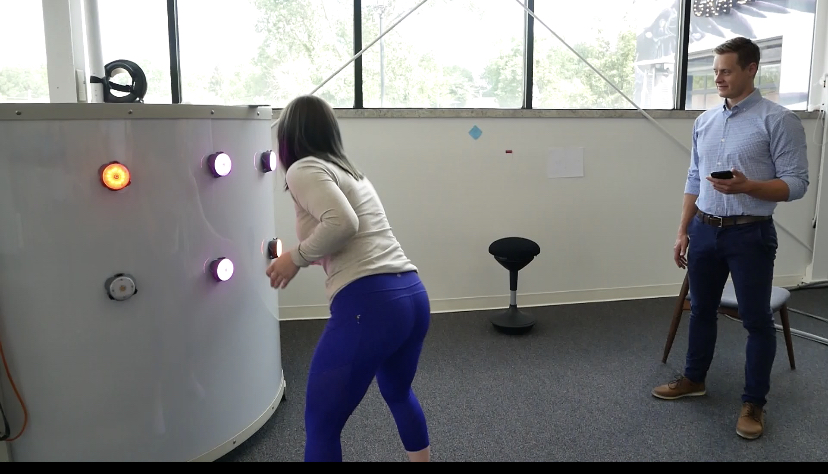
OK so today we're going to talk about a concussion case. This case is interesting because it gives us a good insight into the overlap between the connection between brain injury from a concussion and also neck injury, which a lot of the time goes hand in hand.
Who She Was When She Came In
The patient we're going to discuss is a 27-year-old female. She came to us with a chief complaint of headaches that had persisted after a concussion. She initially had a hit to the head that left her feeling immediately disoriented. When she tried to go back to work over the next couple days, she noticed she was very foggy, she had a hard time focusing on her work especially if there was a computer, she was sensitive to light, and she had a headache that did not seem to go away.
These symptoms persisted over a couple months and then were exacerbated when she had an injury to her neck subsequent to the concussion. She had a couple of jolts to her neck — the first one was when someone accidentally hugged her really tightly and her neck moved quickly from side to side. The second and third were ones where she was actually in a car and they were injuries where she braked quickly, causing her to have that whiplash type injury to her neck.
The initial concussion and then subsequent injuries to the neck left her when she arrived at our office having persistent daily headaches, a lot of feeling of disorientation when she was upright, kind of feeling off, a lot of brain fog, fogginess, tiredness, exercise intolerance, lightheadedness when she was upright, and then also a lot of anxiety that had persisted since the initial concussion and then had been compounded when she had the subsequent injuries to her neck.
What We Found on the Exam
We started with a physical examination. A major finding that we found for her was that she had a positive scapulohumeral reflex bilaterally. So we find this when you take your reflex hammer, you tap the acromion of the shoulder here, and basically nothing should happen. A normal response is that we do that, nothing moves, the patient feels fine. But for this patient, what we see is that when we tap, you have an exaggerated or a movement type of response — so the arm moves or the neck moves. She had that on both sides. This tells us that there is an injury going on in the top portion of the neck.
We also saw that she had exaggerated reflexes when we checked the reflexes in her legs — so her patellar reflex and her Achilles reflex — we had more of a response than we would want. She had really restricted and guarded cervical range of motions, both when we were trying to move it as well as when she was moving it. She had a lot of anxiety about moving her neck because of the injury that had come from her accidents, and therefore she hadn't been doing a ton of moving it because it was both uncomfortable as well as caused her a little bit of stress to think about moving it or letting someone else move her neck.
We also saw that when she would walk back and forth, she had a loss of arm swing on the right hand side.
What Her Eyes Told Us
Looking at her eyes, a couple things that were important — we noticed that on her Maddox Rod she had an esophoria. So her eyes, when she was looking far away, instead of staying lined up perfectly, they would deviate inwards. Looking at her VOG — so when we used the video oculography to look at her eyes — we saw that this persisted. So on the tests where she was looking in the dark, there's basically nothing for you to look at, you're just looking at a dark screen or a dark room, her eyes would do the same thing — so they would come in. We call it a convergent spasm.
When she had things to look at — so both when she was holding a target as well as when she was slowly pursuing a target backwards and forward, right to left horizontally as well as up and down vertically — she had square wave jerks. So these are where we see, instead of your eyes maintaining fixation on that point, they lose it for a minute and you get a little jerk. It's really fast, so faster than you can actually feel as a patient, but we know that this is coming from the inability to maintain fixation.
“When we looked at her eyes, the ratio between the veins and the arteries was not what we would want to see. There was constriction in the arteries — and the answer to that came a lot from when we actually did her autonomic testing.”
Another interesting thing we saw when we looked at her eyes, both us here in the clinic using the fundoscope and then when we sent her out for a fundus photo — we saw that the vein-to-artery ratio was not what we would want to see. So ideally the size of these two things, the veins and the arteries, should be relatively similar. What we saw for her was that there was constriction in the arteries.
The Tilt Test — Where It All Came Together
The answer to that came a lot from when we actually did her autonomic testing, or her tilt test. A couple things that were important: we noted that right away, even when she was laying down before she even went up into orthostasis, she had hypocapnia. So her end-tidal CO2 levels — basically the amount of carbon dioxide that she's breathing out with every breath — were low.
So one of the things when we think about the amount of carbon dioxide in the blood, we use the breath as a proxy for this test — it tells us whether specifically the vessels that are in the head should be constricted or dilated. So when we have low end-tidal CO2 levels, we're going to have vessel constriction. This matched with the finding when we looked in her eyes of seeing those arteries a little bit too constricted. This is something that we often see with migraines or headaches — it's actually that vascular constriction in the head which prevents us from having as much blood flow as we would like to that area.
So when she went up for orthostasis, we brought her up to 70 degrees of tilt and had her stay there for 10 minutes. We saw that the hypocapnia actually got a little bit worse — so it was worse when she was upright — and then she also had cerebral hypoperfusion. So when she went upright, she was unable to maintain the amount of blood we would want in her head. In the first minute we want it to be above 90% of your baseline value, and then in all subsequent minutes we want it to be at least 80. She wasn't doing that. So she was hypoperfused.
Because of these two things — the hypocapnia making the vessels constrict makes it harder to push blood into your head, plus the hypoperfusion — she had a consequential increase in heart rate. So the heart said, “I'm going to do what I need to do in order to just try to get blood to the head,” and she would increase the heart rate there.
What We Did About It
So thinking of treatment for this patient, we had to look at a couple different avenues. We know we had to address the neck because we had that positive scapulohumeral reflex and the injuries to the neck. We also know we had to address the perfusion — so make sure that we were having enough blood flow going to her head. And then we also had to address the dysfunction that we were seeing with the eyes — the convergent spasm of the eyes as well as the square wave jerks that we saw with the pursuits and the gaze holding.
So we started with this patient doing some manual mobilizations of the neck and upper back. These were easy things where we would do smooth motions of the neck into different ranges of motion, allowing her to feel what the motion feels like, to make her more comfortable in moving the neck more comfortably. We also gave her exercises that were going to strengthen the posterior part of the neck and between the shoulder blades.
A lot of the times what we see is when we have a neck injury or when we're not feeling very well, or with a lot of people who work highly on the computer looking at phones — basically our everyday life nowadays — we have a lot of tight musculature in the front of our neck and a lot of weak musculature in the back of our neck and around our shoulder blades. So we get this forward hanging, or anterior head carriage, with weak musculature back here. So what we worked on for her is exercises that were going to strengthen the posterior aspect of the neck — band exercises where she was retracting her arms backwards, exercises where she was learning to retract her chin.
We also started to work on some of the dysfunction we saw with the eyes. So we had her doing a gaze stabilization exercise — basically where she holds a target and she moves her head back and forth, left to right as well as up and down. We had her doing a Brock string exercise, which is what allowed us to start working on correcting some of those depth field errors — this is where you have a string with beads, you're looking at the string at different depths and working on coordinating the motion of your eyes as they come in and out, so into convergence and into divergence.
We also did a whole body rotation where she sits in the whole body rotation device, her eyes hold on to a target, and we were spinning her towards the right hand side. To complement these, we also used photobiomodulation — or basically like a red light or a laser therapy — we did this highly focused on her neck and then also into her head and brainstem.
And then we also started to use exercise with oxygen therapy. So we wanted to do this to start to raise those end-tidal carbon dioxide levels. We exercised her in a position where we know she could keep blood flow to her head — so for her that was in a laying down position — and she would do exercise where she was doing actually like a supine cycling, and we would either monitor that end-tidal carbon dioxide or give her supplemental oxygen to work with so she could exercise and start to raise those levels.
The Results at Two Weeks
So as we're going through treatment, we always re-evaluate our objective findings. A really cool thing that we found for her was that we did a follow-up tilt test about week two of her treatment. On her follow-up tilt test, we had no more cerebral hypoperfusion — so she was able to maintain the levels of blood flow that we wanted to see. She was slightly hypocapnic when she went up for that tilt, but the levels were a lot better than we had initially seen. So we know we just needed to keep on exercising her. And then she didn't have the compensatory increase in heart rate to those things.
“When we fixed the perfusion — so we were able to keep her blood in her head — she didn't have to have that increase of heart rate that we saw in the first tilt table test.”
An interesting thing for this patient is that on her initial tilt table test, she actually did meet the criteria for POTS — so she had no drop in blood pressure, she had some of the lightheadedness type symptoms, and she had an increase in her heart rate of over 30 beats per minute. Sometimes it's not the most important thing to focus on because it's not the most adequate representation of what was actually going on with this patient. Her symptoms were actually coming from the less blood flow to the head and the hypocapnia. The increase in heart rate was just the compensatory mechanism.
So sometimes that diagnosis of POTS is something that we're looking for — we might know we have it or we might find out during the tilt test — but it's not the most accurate representation of what's going on. So the cool thing for this patient is that when we fixed the perfusion, so we were able to keep her blood in her head, she didn't have to have that increase of heart rate that we saw in the first tilt table test.
Eye Movements and Reflexes — All Improving
We also redid the eye movements when we looked at the video oculography. So we saw a decrease in frequency of those square wave jerks when she was doing the gaze holding as well as the pursuits, both backwards and forwards and up and down. She did not have any more of the convergent spasm when she was looking in the dark. And we saw an improvement of overall her vergence responses with the exercises — so she was able to bring her eyes in and bring her eyes out when they were supposed to, both following a target and then when she was in the dark they didn't deviate inwards into that eso deviation.
We also saw that the vein-to-artery ratio started to normalize over the course of treatment, which was really great. She had, by the end of treatment, a negative scapulohumeral reflex — so when we did those tests on her shoulder blades, she no longer had the extra movement. Those normalized, as well as the hyper-reflexive movements in her lower extremity — so with the patellar and the Achilles, we saw those normalize.
We also saw that her neck mobility and her comfort with moving her neck was drastically improved. And when this happened, she also started to see a reduction in the frequency and intensity of her headaches. The lightheadedness started to go away. Once she realized that things were moving in the right direction, a lot of the anxiety that was associated with the discomfort that she felt also started to be reduced.
“When we have you actually getting as much blood flow as you want to your head when you're upright, those feelings of being overly tired, disoriented, feeling off — those also start to dissipate as well.”
Going Home and Continuing to Improve
This patient went home with a home exercise program that was tailored to her. She was continuing to work on strengthening the muscles around her neck and keeping them moving. We continued to work on exercises with her eyes and then coordinating the eyes with the head — so strengthening exercises, exercises where she's moving her eyes, and then exercises where her eyes and her head are moving at the same time. And we wanted her to start introducing exercise back into her life because that was something that was important and made her feel good in her everyday life.
Ready to Start Your Recovery?
If you've been dealing with headaches, brain fog, or POTS symptoms after a concussion or neck injury, a free consultation call can help figure out whether our approach fits your situation.
I'm Ready to Get Better