When you experience post-exertional malaise or a crash, it can feel like you caused damage that's permanent. Irreparable. And that's really hard because it creates this cycle where you feel like you have to stay within a certain energy envelope, but you also somehow have to break it to get better.
There's actually an important window in being able to push that forward — as long as we understand what the underlying constraints are. Like, what are the rules of the game that we have to operate in to push that energy envelope effectively?
I don't have a one-size-fits-all for everyone to solve post-exertional malaise. But what I will talk about are the concepts that are important so that in your particular body, we can understand what the rules are and how to play within those rules.
The Energy Production Story Has a Problem
So the common perception of ME/CFS is that it's an energy production issue, right? You may hear it described as a problem with the mitochondria being able to produce enough energy, or maybe not enough mitochondrial activity. People think this because it's the common thing that's taught.
It becomes problematic though. Because the more you practice decreasing energy, the more your body is going to be incentivized to decrease the machinery needed. If you're laying down all the time, it turns out we become really good at laying down. And that's not so great for standing up.
We know this because we can look at studies where they compare athletes versus normal people on bed rest. Whether you're an athlete or a normal person, it doesn't take very long for your body to start changing — plasticity, actually modifying its own outputs to match what you're doing. It's kind of like, "Oh sweet. We lay down now. We can just throw all this stand-up stuff overboard. We don't need it anymore."
What Bed Rest Actually Does to Your Body
If you're just a normal person, within two days of bed rest, we start to see a relative hypovolemia. A lot of you will perk up to that because if you've been diagnosed with POTS or anything orthostatic, they talk about low blood volume a lot. But we know — if you don't have to push blood up to the head, the necessity to distribute blood goes down. The body responds to that.
Within about four days, we start to see neurally mediated changes. Your brain starts to downregulate all the processes that go with standing up because you're not doing it. This is the same thing we see when we send people off into space and they don't have to deal with gravity anymore. Not only does it affect your ability to detect upright, it starts to make your muscles atrophy. All the systems that resist gravity just become less useful.
The radical rest problem: On one hand, you don't want to do too much because it feels terrible and doesn't seem to progress into anything useful. But on the other hand, by resting exclusively, you're taking on the role of degenerating the systems within your body. You're creating the deconditioning that people are accusing you of. We have to split the middle.
So we have to figure out: how do we dose activity appropriately so we're stimulating not just the whole global system, but the areas that are specifically problematic? How do we take all that stored energy and push it into the one system that is the linchpin — the catalyst that will allow the whole system to start being able to do those activities again?
That part's probably what we're missing. Because it's a little bit of Goldilocks, right? Can't be too hot, can't be too cold. Got to be in the middle. So we have to understand — what is the middle for you?
It's a Brain Problem, Not an Energy Problem
If you have ME/CFS, we know there was a catalyst moment. You were doing great, something happened, and then you were no longer doing great. That becomes the core problem. But then just the function of what that does to knocking you out of the game starts to create knock-on effects — deconditioning problems that aren't even necessarily the same ones from the original problem.
For many people, that original problem revolves around how we manage blood flow into the brain. ME/CFS is a neurally mediated problem. It's a problem in the nervous system, which translates to — it's a problem in your brain.
So what we want to focus on is rather than saying "let's just condition you, let's get you a trainer, let's get you in the gym and gut it out" — that's probably not useful. Because there you're creating an energy deficit problem. You're taking all this energy and pushing it into systems you can't control, because the main problem is that you're not able to feed your brain.
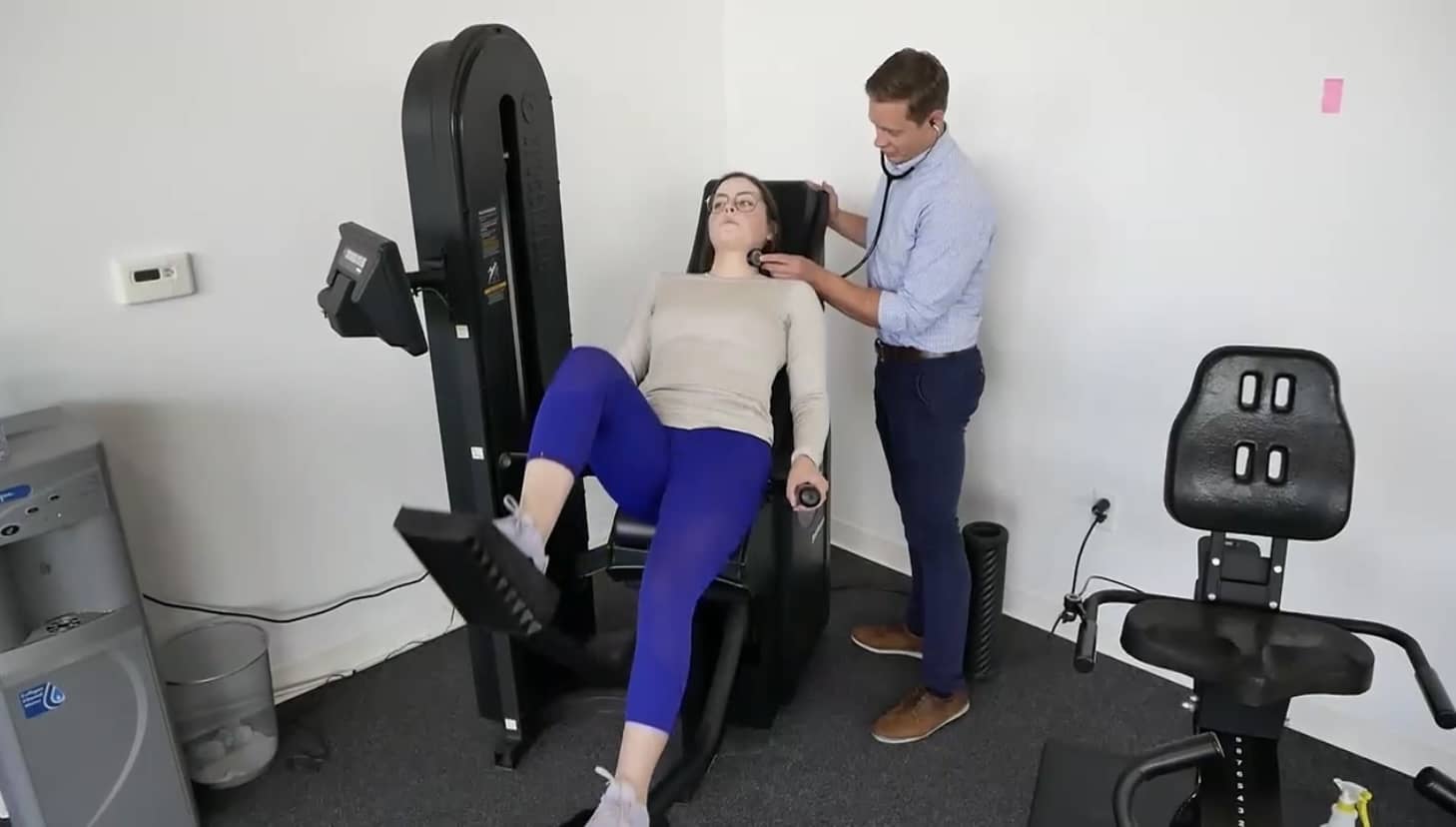
What we want to shift to is thinking about how to exercise those systems within the brain that manage how all of this works. And you're not even exercising the whole brain. You're taking care of resuming function in very specific areas that allow you to get blood flow back in.
Turns out if you can get blood flow to your brain, it's much better at controlling the entirety of the rest of the system. Which then allows you to generate neuroplasticity, activate mitochondria, get more density, and produce more energy.
So if we turn the problem on its ear and just look at it slightly differently, it allows us to take this huge problem and focus it into a very small area that becomes much more manageable.
What We Can Actually Measure
The unifying factor in a vast majority of ME/CFS cases: number one, we can measure that when you're upright, the amount of blood flow to your brain is less. And number two, the relative amount of end-tidal carbon dioxide is less. These point to problems with getting enough blood flow to operate your brain well — and then we get all the knock-on problems that come with that.
So rather than focus on overall fitness — that's the goal later — the first goal is can we start to get that fitness back in the brain.
Same way you think about graded exercise, right? Start slow, work up. Use that same concept but understand it in terms of: how do these reflexes within my nervous system need to dose up and get stronger so I can tolerate sitting up? Tolerate sitting up for a long time? Tolerate standing? Tolerate standing and then moving my head, and then also talking to people, and then also walking, and then running or jogging or rowing or whatever it comes to?
If we take it in those small steps where the brain is getting better at getting blood flow into it, we open up huge doors to allow the system to connect to all the things that go with getting back upright, getting back into the world. And then we're not fighting directly with the energy envelope. We're focused on getting blood flow first, and then watching that energy envelope expand from there.
What "Exercising the Brain" Actually Means
OK so the idea of exercising your brain can feel foreign, a little bit confusing. But normally people think if you're exercising your brain, you're doing math, learning languages, standing on one foot hopping around. That's not really what I'm talking about.
When you think about all the things that go with standing upright, almost none of them do you ever have to think about. They're automatic. This is where "autonomic" comes from. Another way to think about that is like a reflex. Reflexes happen automatically. But in these cases, what we find is there's a consortium of different reflexes that can have errors with the way they talk to each other:
- The way you feel blood pressure in your body, in your neck, or in your brain
- The way your body interprets pressure in your heart or lungs
- The way you're breathing
- The amount of oxygen in your blood
All of these go together to create the big picture of how to distribute blood through the system. So we take them all apart and think about how each is working individually, and how they work when combined with other tasks. That helps us dial in on where to aim.
Most people don't start from a position where they can do a lot of things. If they could do them already, it wouldn't be a problem. It's just like if you're learning to do a pull-up for the first time and you can't do one — someone's spotting you, or you're using a band. Your ability to do one on your own isn't there yet.
A lot of what we're doing with people is giving them a stimulus — a small enough stimulus that their body can interpret it. We see the outcome, the reflex starts to work again, and then you're building it. Graded exercise for reflexes. You build that stimulus up until the person is able to start doing things on their own and scaling on their own.
The Systems That Break Down
So we know the starting place for a lot of people is understanding this problem of cerebral blood flow. We can measure it. It's easy to do. But from there we have to say — well, what caused that? Which one of these systems is breaking down?
You may have a problem in the vestibular system — your balance system. Some people have seen where they go to the fair, get on the Tilt-A-Whirl, get off, puke, they're dizzy, all of it — because it overwhelms their inner ear. For people in this cohort, just going from laying down to standing up is like riding that Tilt-A-Whirl. It overwhelms the system. They can't compensate, and then we see errors in distributing blood flow.
Some people have problems in the baroreceptors in their neck where something happens — maybe they injured their neck or had an infection. Now they have a hard time sensing how much blood pressure is changing with every heartbeat, with every breath. Too much fluctuation, and then we get a problem.
Some people have problems with autoregulation — the blood flow management happening in the brain. This was a big one with people who had endothelitis, our post-COVID group, where that system didn't work the way it's supposed to. You could have normal blood pressure all the way up into your neck but no transfer into the systems in the brain.
Some people — it's a car accident. A neck injury where the sensors in the neck create that same Tilt-A-Whirl feeling when turning the head, and it affects the brain's ability to control blood flow.
All of these things that have to do with posture, balance, detecting movement, detecting changes in pressure — they're all potential attack vectors where, when something happens, the downstream effect is that it ultimately affects our ability to get blood to the head when standing up.
Finding Your Way Forward
We started this conversation talking about the fact that there isn't a universal fix. Hopefully that's become a little more obvious as to why.
But even though there's no one-size-fits-all solution, we still have to find a way to get a solution, right? So the place we start is: are we getting enough blood flow to the brain? From there, what are the systems involved? When I stress them, when I test them, how do they affect that cerebral blood flow?
Then that gives me a window to say: I'm going to take my energy envelope — the amount of energy I have — and focus it on improving the fitness in that one system. When I improve the fitness in that system and measure it, does it start to have effects on how the whole system works together? Can I measure those changes in cerebral blood flow? Can I start to see outcome changes where we can do more things?
Because doing more things is what turns into feeling better. It doesn't usually go the other way around. If you've been in this place for a long time — and I know a lot of people have, and it sucks — there's an amount of building yourself back up that's necessary. This becomes the avenue to do it. As you can do more, the feeling better starts to come with that.
Ready to Break the PEM Cycle?
If post-exertional malaise keeps pulling you backward, a free consultation call can help determine whether our approach fits your situation.
I'm Ready to Get Better