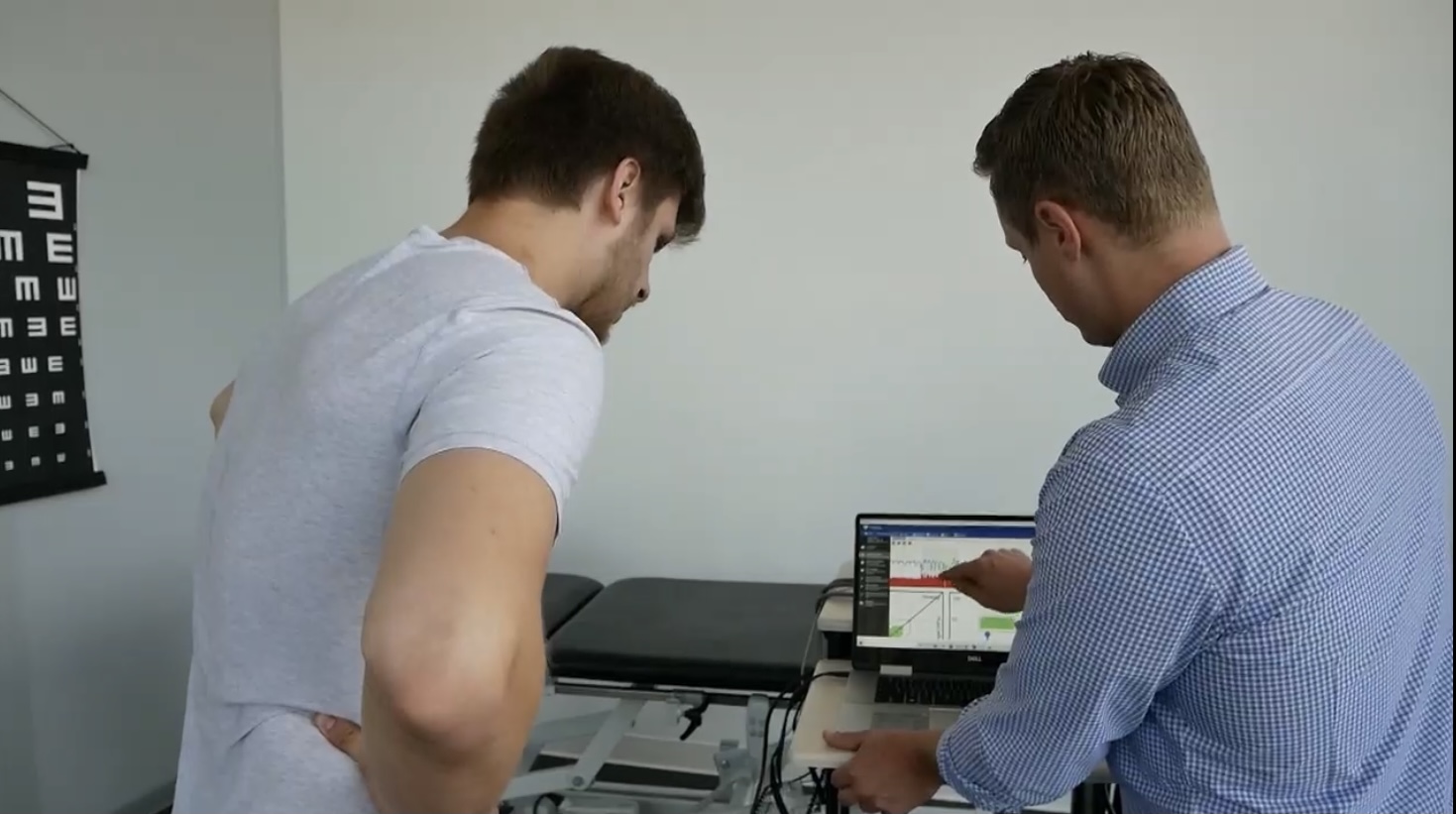
We're going to talk about proof that the brain controls the autonomic system. It should be no surprise because the autonomic system is part of the nervous system. But what's really cool is when you can actually see it — when you stimulate a specific pathway in the brain and then watch the autonomic outputs respond.
A Case: Fatigue, Exercise Intolerance, and Brain Fog
We had a patient in not that long ago. Her primary complaint was fatigue and exercise intolerance. She would get out of breath and really tired doing things that previously she didn't have any problem with. She used to be able to walk her kids to the pool without an issue, and now she was getting out of breath just walking them to the bus stop.
She used to be able to do an exercise class for 45 minutes, no problem. And then as her symptoms started getting worse, she'd struggle to do half an hour, and then afterwards she'd have to rest for a couple hours just to feel like she could do something else after that.
She also had some brain fog. This particular patient — tons of education, hadn't struggled with stuff in the past — and she'd noticed that her productivity had really dropped. She was working on a master's program and really struggling to get stuff done, struggling to help her kids with their homework because of the brain fog.
What Testing Showed: Coordination, Perfusion, and the Left-Right Connection
Some of the things we noticed: she had really decreased cervical range of motion. The muscles in her neck were super tight, and that was limiting some of that motion. We noticed some decrease in coordination on the right side. And when we did the tilt, she had cerebral hypoperfusion kind of isolated more to that left side.
So when we say coordination problems — we'll have people take and touch their nose to a finger back and forth. That should be relatively coordinated. But she was getting some tremors in there, not quite finding the target. If we have her do different tasks like moving her hands back and forth, there would be floppy and not quite coordinated. The timing was off a little bit. So that lack of coordination is kind of like there's a wobble in it. The feedback loop isn't quite running hot.
We noticed that on the right side. And the right cerebellum correlates with the function of the left brain. So when we see decrease in the perfusion to the left brain and also decrease in coordination on the right, we're starting to see a tie-in between the two. The left brain's not getting the blood flow that it needs to run the task that it wants to run, and also some of the coordination on a corresponding pathway is off.
"The left side of the cerebral cortex has a map for the entire right side of the body. So it's like all the sensory stuff on the right side is going to be integrated over here. It crosses over. And then when it kicks out the motor program again, it kicks it out over that opposite side."
Saccadic Eye Movements: A Window Into Brain Function
So we test saccades, which is quick eye movements back and forth. If I tell you to look at this point and then look at this point and go back and forth between those — that's a saccade. We want the eyes to jump smoothly from one to the other.
A saccade is a certain type of movement that comes from the frontal eye fields. It's really important because it's different than anything else. It's a shift. Your eyes are actually jumping to a target in space, which means your brain has got to know where it's going before it even leaves, right? So it's throwing a dart. Once that dart leaves your hand, you can't change it. It's going to land.
So we're measuring how well someone can land their eyes on that target. And also how quickly they react to notice that target and then get the machinery of their eyes over there — that's a processing component. And then we look at how does that look when it's going. Does it take the normal speed arc to get there or does it have stops and starts along the way?
What we should see is one beautiful peak going up and then back down. In hers, it goes up and then there's a little bump in the middle and then it comes down on the other side. We call that an omnipause intrusion. A lot of times when that pops up, we actually see people who are recruiting their head in the middle of their eye movement. It's an indicator that there's some asynchrony in the way the eyes and the head are able to communicate with each other. It changes the trajectory of the eye movement.
We Didn't Practice Saccades — But They Improved Anyway
This is the really cool part. After only 3 days, the saccades looked completely different. And it's interesting to note that we actually didn't have her practice these saccades at all between the first test and the second one. We did a couple of other things with her eyes, but we mostly worked on her neck and then some gaze stability stuff.
And you can see that the velocity graph is now more of a nice easy peak. That M that was in the middle is no longer there. It's now more of what we like to see where it goes right from the start and lands smoothly. And she's landing closer to the target — not overshooting it as much as she was before.
She also completely cleared up the orthostatic cerebral hypoperfusion. Her perfusion was good for the entirety of the tilt test. And she told us that she decided to do a whole workout class at the end of the day and felt wonderful, didn't have to rest for hours afterwards, and was able to wash her hair, which she was super excited about.
"We didn't do anything to try to manipulate making her better at doing saccades. But by stimulating the pathway of choice and being able to stimulate that portion of the brain, we can see that the whole system runs smoother."
The Research: Eye Movements and Cerebral Blood Flow
What we know that's pretty amazing — that we've known forever — a study published in 1994 basically showed that when you do saccades, when you do visual fixation, just holding your eyes steady, you can measure cerebral blood flow to the point where we use it to qualify what areas of the brain we're stimulating. Which is amazing.
So at that time they were able to say: when we do these saccades, we can see increased perfusion into the posterior parietal cortex, the extrastriate cortex, the frontal eye fields — during both reflexive and remembered saccades. And then there's additional activation in the supplementary motor area, the cerebellum, the thalamus, the midbrain.
Why do I bother bringing this up? Because in order for those saccades to generate, it means we have to have a pathway that's active through that whole system. And what's amazing is by looking at these different tests, it gives us ways to understand where in that pathway things are becoming errored. And then how do we stimulate things that are pre-synaptic — which means like a train station. We want to do things that are earlier on, before your stop, so that when we fire that signal up, it's able to change the activity in the portion of the pathway we want to change.
Building Capacity vs. Building on Dysfunction
There was a great question from the audience: "When you attempt to build capacity on dysfunction, you're actually deepening the attractor state of your compensation. Thus, you're building compensation, not capacity. Does this also relate to dysautonomia?"
I think that's a wonderful way to state it. So if you are building more capacity on dysfunction, it's great in the sense that you're gutting it out, right? You're basically getting better at your dysfunction. That allows you to do more things within the threshold, but you're still kind of doing it the same way.
I played baseball, so if you got a hitch in your swing and your swing is not great, but you just rather than work on your swing, you just get way stronger — you still have a crappy swing, but you're just stronger. You might be able to hit the ball further once you make contact, but you may not hit it as far as you could or as often as you could, right?
Dysautonomia is precisely the same. If we don't address the underlying component, we still have a vulnerability to it. I may have more capacity but I'm still having the same vulnerability that allows me to crash back to that baseline level. By addressing that one component — the part that is the lynch pin, the part that is not working well — it unlocks the ability to then go through that door to affect the whole. So by addressing that one component, we oftentimes have the ability to make the whole system run better and then build real capacity.
Heart Rate Response After Perfusion Normalizes
Another great observation from the audience: once the cerebral perfusion normalizes, there's often still an exaggerated heart rate response. Is the brain predicting an issue that is no longer there?
In the early phases of getting that system back online, there is an interim period where we're able to see that cerebral blood flow improving, which is wonderful. It means that the brain is recognizing that we need the blood flow there and it's delivering. But one of the ways it's going to deliver best early on is to still elevate the heart rate. It's saying like, "Oh, now I get that I need to get more here, but I'm still not all the way there. I still need to use more heart rate to get there."
But then as that system becomes more efficient, you need less and less output of that heart to maintain that. It'd be kind of like lifting a weight — I might need so much more effort to get it up and be able to get it off my chest. But as I get better at it, it takes less and less effort. So in the early days, there takes more effort. We see that heart rate is still elevated. And what we're looking for is to be able to maintain that perfusion but take less effort in order to do so. We get more efficiency out of the system and then that heart rate can come down.
Why Symptoms on the Same Side Can Happen
A lot of people get confused by the mirroring — where the left hand is affected by the right brain.
The right side of your brain has got a little unlock because it carries a bit of a correlated map for both sides. It's a little fail-safe that we have. But the neurology is going to cross, while the perfusion is going to be unilateral — it's going to affect everything on that one side. So we can see cases where the perfusion is going to affect things not only contralaterally but ipsilaterally as well because we're knocking out the whole system.
But when we see things where we're actually creating a sensory barrage that is skewing activity in the brain, it's going to change the cerebral blood flow based on the activity that's coming from the sensory system. And that helps us to be able to refine the diagnosis of which one becomes the tail wagging the dog or the dog wagging the tail.
We can't just say, "Oh, my tremors are over here" and then quickly say everything must be on the other side. We have to overlay what is happening from looking at the neurological pathways and then looking at the vascular system over top of that and then put them together.
So What Does This Mean for You?
If you are someone that is having trouble being able to direct blood flow to the brain, we can use eye movement strategies to stimulate those particular components. Or if we're trying to work on things that are pre-synaptic to it, we can use stimulus through other parts of the body — the vestibular system, through eye-head movement, through neck proprioception — and we can measure the outputs in these other systems that are part of those pathways.
Anything that we would be able to observe and measure also has a potential to be a therapeutic intervention. So in some cases we might use those saccades as a way to provide an input, a stimulus that stimulates the brain in a way that we can measure. Those windows become useful from both an evaluation perspective and a treatment perspective.
Ready to Find Out What's Driving Your Symptoms?
If nobody has looked at how your brain is controlling your autonomic system, a free consultation call can help determine whether our approach fits your situation.
I'm Ready to Get Better